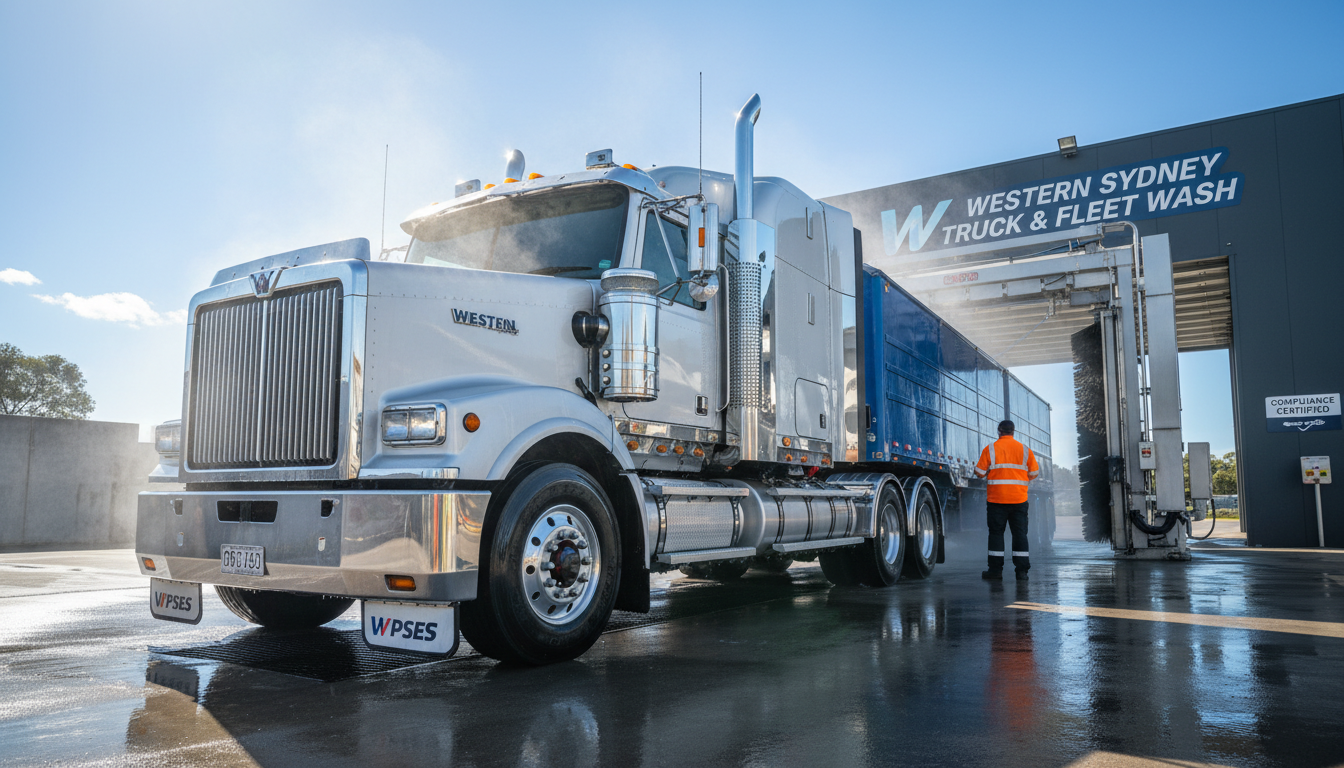
RTA Wash compliance is a critical step for heavy vehicle operators preparing for Transport for NSW Heavy Vehicle Inspection Scheme assessments. While the Heavy Vehicle National Law (HVNL) does not explicitly mandate a pre-inspection wash, Transport for NSW inspectors require vehicles to be sufficiently clean to assess structural integrity, brake components, and chassis condition. Vehicles presented with excessive dirt, mud, or grease may be rejected until properly cleaned, delaying compliance and costing operators time and revenue.
Eagle Truck Centre has delivered RTA Wash Services across South West and Western Sydney since 2015. Our Smeaton Grange and Emu Plains facilities offer pre-inspection washes designed to meet Transport for NSW standards, ensuring your heavy vehicle is inspection-ready and compliant with roadworthiness obligations.
What Is an RTA Wash and Why Is It Required?
An RTA Wash is a specialist heavy vehicle cleaning service designed to prepare trucks, trailers, and rigid vehicles for Transport for NSW Heavy Vehicle Inspection Scheme assessments. Unlike standard truck washes that focus on exterior appearance, RTA Wash services target undercarriage components, chassis rails, suspension assemblies, brake systems, and steering linkages—areas that inspectors must assess to determine roadworthiness under the Heavy Vehicle National Law (HVNL).
Transport for NSW data indicates that around 15% of heavy vehicles presented for inspection are issued defect notices, with visibility of critical components often cited as an inspection barrier. Excessive buildup of mud, grease, and road grime obscures structural defects, corrosion, and component wear, preventing inspectors from completing their assessments. Vehicles rejected for cleanliness must be re-presented after washing, causing scheduling delays and potential breaches of registration or permit timelines.
RTA Wash is not a cosmetic service. It is a compliance enabler that supports your obligations under HVNL Section 26C, which imposes a duty to ensure heavy vehicles are not used unless they are safe. By removing contaminants that obscure defects, RTA Wash allows you and Transport for NSW inspectors to identify maintenance issues before they become roadworthiness failures or safety incidents.
Heavy Vehicle National Law (HVNL) and Cleanliness Standards
The Heavy Vehicle National Law (HVNL) does not specify a cleanliness standard for heavy vehicles, but it does impose a duty on operators, drivers, and other parties in the chain of responsibility to ensure vehicles are maintained in a safe condition. Under HVNL Section 26C, a person must not use or permit the use of a heavy vehicle on a road unless the vehicle is safe. This duty extends to ensuring that vehicles are maintained in a condition that allows defects to be identified during routine inspections and regulatory assessments.
Transport for NSW inspectors apply this principle by requiring vehicles to be clean enough to assess all safety-critical components. If excessive contamination prevents a thorough inspection, the vehicle will be rejected and the operator will be required to re-present the vehicle after cleaning. This is not a discretionary standard—it is a practical requirement for meeting your roadworthiness obligations under the HVNL.
How RTA Wash Supports Transport for NSW Heavy Vehicle Inspection Scheme Compliance
The Transport for NSW Heavy Vehicle Inspection Scheme requires inspectors to assess chassis rails, suspension components, brake assemblies, steering linkages, axle assemblies, and identification plates. These components are often located in areas exposed to road spray, mud, and grease, making them difficult to inspect without prior cleaning. An RTA Wash ensures that all inspection points are visible and accessible, reducing the risk of rejection and supporting a smooth inspection process.
According to the National Heavy Vehicle Regulator (NHVR), heavy vehicle defects contribute to approximately 3% of fatal crashes involving articulated trucks in Australia, with poor vehicle maintenance identified as a key factor. Many defects—such as cracked chassis rails, worn suspension bushes, and corroded brake lines—are only visible once contaminants are removed. By scheduling an RTA Wash before your inspection, you enable both your own pre-inspection checks and the Transport for NSW assessment to proceed without obstruction.
Operators who understand what to expect during an HVAIS inspection recognise that cleanliness is not optional. It is a prerequisite for demonstrating that your vehicle meets the maintenance standards required under the HVNL and that you have fulfilled your chain of responsibility obligations.
What Level of Cleaning Does RTA Wash Compliance Require?
RTA Wash compliance requires more than a quick rinse. Inspectors need clear visibility of structural and mechanical components, which means removing caked mud, grease, oil residue, and road grime from undercarriage areas, brake assemblies, and chassis rails. Standard truck washes that focus on cab and trailer exteriors do not meet this standard.
Specialist RTA Wash services use high-pressure water systems, degreasing agents, and undercarriage wash equipment to target inspection-critical areas. This includes pressure-washing chassis rails, suspension mounts, brake drums, brake lines, steering linkages, axle assemblies, and fifth wheel coupling points. Wheel wells, tyre sidewalls, and identification plates must also be cleaned to ensure legibility and allow for tread depth and damage assessment.
Operators choosing between detailing and high-pressure wash services should prioritise undercarriage and mechanical component cleaning for RTA Wash compliance. Cosmetic detailing does not meet Transport for NSW inspection standards.
National Heavy Vehicle Regulator (NHVR) Mass, Dimension and Loading Requirements: Why Clean Vehicles Matter
Excessive mud, debris, and buildup can add unaccounted mass to your vehicle, potentially causing breaches of axle mass limits under National Heavy Vehicle Regulator (NHVR) Mass, Dimension and Loading requirements. Operators who weigh their vehicles without accounting for contamination may unknowingly exceed legal axle mass limits, resulting in infringement notices and penalties.
The Bureau of Infrastructure and Transport Research Economics (BITRE) reports that the Australian heavy vehicle fleet travelled over 18.9 billion kilometres in 2022, underscoring the importance of consistent compliance and maintenance practices across the industry. Regular RTA Wash services ensure accurate mass compliance by removing contamination that can distort weighbridge readings and affect load distribution calculations.
Under the Work Health and Safety Act 2011 (NSW), operators also have a duty to ensure that vehicles are maintained in a condition that does not pose a risk to workers, drivers, or the public. Excessive buildup can obscure defects such as cracked chassis rails, corroded brake lines, and worn suspension components, increasing the risk of mechanical failure and workplace incidents. RTA Wash supports your WHS obligations by enabling proper defect identification and timely maintenance intervention.
Common RTA Wash Compliance Failures and How to Avoid Them
Operators who present vehicles for inspection without adequate cleaning risk rejection and re-inspection delays. Common compliance failures include insufficient undercarriage cleaning, failure to degrease brake assemblies, obscured identification plates, and excessive mud buildup in wheel wells and suspension areas.
To avoid these failures, book your RTA Wash 24 to 48 hours before your scheduled inspection. This allows time for the vehicle to dry completely and for you to conduct a final pre-inspection check of all components now visible after cleaning. Operators who integrate preventive maintenance practices into their fleet management routines recognise that RTA Wash is not a one-off service but a regular compliance requirement.
Industry Data
- —According to the National Heavy Vehicle Regulator (NHVR), heavy vehicle defects contribute to approximately 3% of fatal crashes involving articulated trucks in Australia, with poor vehicle maintenance identified as a key factor.
- —Transport for NSW data indicates that around 15% of heavy vehicles presented for inspection are issued defect notices, with visibility of critical components often cited as an inspection barrier.
- —The Bureau of Infrastructure and Transport Research Economics (BITRE) reports that the Australian heavy vehicle fleet travelled over 18.9 billion kilometres in 2022, underscoring the importance of consistent compliance and maintenance practices across the industry.
Another common failure is presenting vehicles with water still pooling in undercarriage areas or brake assemblies. Water can obscure rust, corrosion, and structural defects, leading inspectors to request re-presentation once the vehicle has dried. Allow sufficient drying time after your RTA Wash to ensure all components are fully visible.
Pre-Inspection Wash Checklist for Heavy Vehicle Operators
Use this checklist to ensure your vehicle meets RTA Wash compliance standards before presenting for Transport for NSW inspection. Operators who follow a structured approach reduce the risk of rejection and demonstrate their commitment to chain of responsibility obligations under the HVNL.
- ✓
Pressure-wash undercarriage, chassis rails, and suspension components to remove mud, grease, and road grime - ✓
Clean brake drums, brake lines, and air brake components to ensure inspector visibility - ✓
Degrease engine bay, steering linkages, and axle assemblies - ✓
Remove debris from wheel wells and ensure tyre sidewalls are clean for tread depth and damage assessment - ✓
Wash identification plates, VIN stamps, and compliance plates so they are legible - ✓
Inspect and clean trailer coupling points, fifth wheel assemblies, and load restraint anchor points - ✓
Ensure all lights, reflectors, and number plates are clean and clearly visible - ✓
Allow vehicle to dry completely before inspection to prevent water obscuring defects or rust
Operators who maintain a comprehensive truck maintenance checklist integrate RTA Wash into their broader compliance and safety management systems, ensuring that vehicles are inspection-ready at all times.
Ongoing Compliance: Beyond the Pre-Inspection Wash
RTA Wash compliance is not limited to pre-inspection preparation. Operators who run vehicles in high-contamination environments—such as construction sites, quarries, and agricultural operations—should schedule regular washes to prevent excessive buildup that can obscure defects during routine maintenance checks and driver pre-start inspections.
Under the Heavy Vehicle National Law (HVNL), drivers are required to conduct pre-start inspections before each journey. If excessive dirt, mud, or grease prevents a driver from identifying defects such as cracked chassis rails, worn suspension bushes, or leaking brake lines, the operator may be in breach of their chain of responsibility obligations. Regular washing ensures that defects are visible and can be addressed before they escalate into roadworthiness failures or safety incidents.
Operators focused on keeping your fleet clean and compliant recognise that RTA Wash is a preventive compliance measure, not a reactive service. By scheduling regular washes as part of your fleet maintenance program, you reduce the risk of inspection rejection, improve defect identification, and demonstrate your commitment to safety and compliance under the HVNL.
Eagle Truck Centre has delivered RTA Wash Services across South West and Western Sydney since 2015. Our Smeaton Grange and Emu Plains facilities offer pre-inspection washes designed to meet Transport for NSW standards. Book your RTA Wash today and present your heavy vehicle inspection-ready.
24/7 mobile roadside assistance. Three locations across South West and Western Sydney. Operating since 2015.
Frequently Asked Questions About RTA Wash Compliance
Is an RTA Wash legally required before a Transport for NSW heavy vehicle inspection?
While the Heavy Vehicle National Law (HVNL) does not explicitly mandate a pre-inspection wash, Transport for NSW inspectors require vehicles to be sufficiently clean to assess structural integrity, brake components, and chassis condition. Vehicles presented with excessive dirt, mud, or grease may be rejected until properly cleaned.
What parts of the truck must be clean for RTA Wash compliance?
Inspectors need clear visibility of chassis rails, suspension components, brake drums and lines, steering linkages, axle assemblies, and identification plates. Under the Transport for NSW Heavy Vehicle Inspection Scheme, any area subject to structural or safety assessment must be free of obscuring contaminants.
Can I use a standard truck wash or do I need a specialist RTA Wash service?
Standard washes may not adequately clean undercarriage components, brake assemblies, and chassis areas critical to Transport for NSW inspections. Specialist RTA Wash services use high-pressure equipment and degreasing agents designed to meet inspection readiness standards, reducing the risk of rejection.
How far in advance should I book an RTA Wash before my scheduled inspection?
Book your RTA Wash 24 to 48 hours before your Transport for NSW inspection appointment. This allows time for the vehicle to dry completely and for you to conduct a final pre-inspection check of all components now visible after cleaning.
Does RTA Wash compliance affect my obligations under the National Heavy Vehicle Regulator (NHVR) Mass, Dimension and Loading requirements?
Yes. Excessive mud, debris, or buildup can add unaccounted mass to your vehicle, potentially causing breaches of axle mass limits under National Heavy Vehicle Regulator (NHVR) Mass, Dimension and Loading requirements. Regular washing ensures accurate mass compliance and prevents contamination-related overloading.