
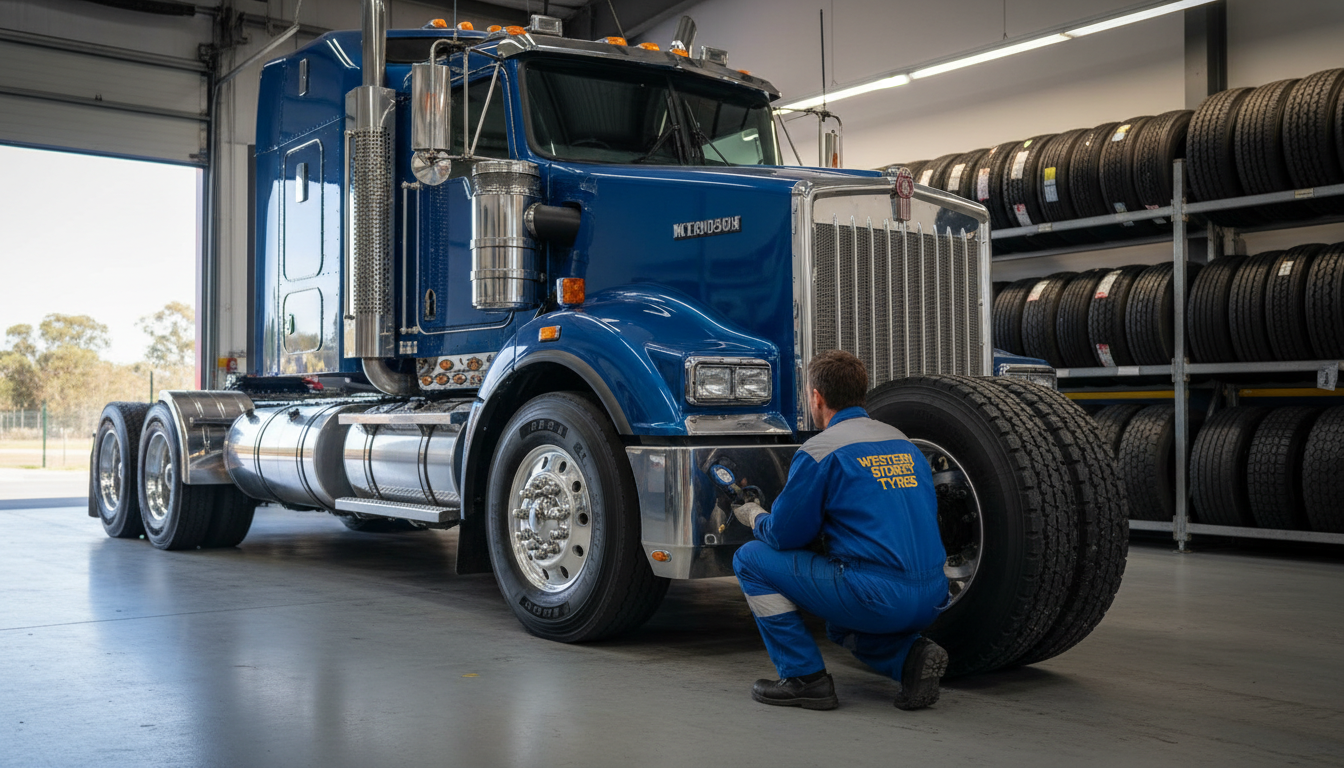
Selecting the right truck tyres Sydney operators rely on requires more than matching size and price. Fleet managers and owner-drivers face a critical decision: choosing tyres that meet National Heavy Vehicle Regulator (NHVR) Mass, Dimension and Loading requirements while matching the specific load weights and distance profiles of their operations. Incorrect tyre specifications lead to accelerated wear, compliance failures during Transport for NSW Heavy Vehicle Inspection Scheme assessments, and increased breakdown risk. This buyers-guide provides a structured approach to selecting steer, drive, and trailer tyres based on load capacity and operational distance, referencing Heavy Vehicle National Law (HVNL) roadworthiness standards and manufacturer specifications for Bridgestone, Dunlop, and Hankook products available through Eagle Truck Centre. For operators managing diverse load and distance requirements across Sydney, our comprehensive fleet tyre selection guide establishes broader selection principles before addressing load-specific considerations.
Understanding Tyre Load Ratings and NHVR Mass Requirements
Every heavy vehicle tyre carries a load index marking on its sidewall, indicating the maximum load capacity per tyre at specified inflation pressure. This numerical code directly correlates to kilogram capacity, and operators must ensure the combined load rating of all tyres on an axle group meets or exceeds the axle loads specified on the vehicle’s compliance plate. The National Heavy Vehicle Regulator (NHVR) Mass, Dimension and Loading requirements mandate that vehicle operators maintain tyres with adequate load capacity for the masses carried, and Transport for NSW inspectors verify tyre load ratings during Heavy Vehicle Inspection Scheme assessments.
A typical steer axle tyre might carry a load index of 141, indicating a maximum load capacity of 2,575 kilograms per tyre at the manufacturer’s specified pressure, typically 8.5 to 9.0 bar for heavy vehicle applications. Drive and trailer axles often require higher load indices, with ratings of 150 or above supporting loads exceeding 3,350 kilograms per tyre. Operators running at or near maximum Gross Vehicle Mass (GVM) or Gross Combination Mass (GCM) must select tyres with load indices that provide adequate safety margin above actual axle loads. Our understanding tyre load index markings resource provides detailed interpretation of sidewall codes and NHVR mass requirements.
The Heavy Vehicle National Law (HVNL) establishes roadworthiness standards that include tyre condition and suitability for vehicle mass. Section 5.2 of the Heavy Vehicle (Vehicle Standards) National Regulation 2013 requires tyres to be appropriate for the vehicle’s axle loads and operational use. Transport for NSW data indicates that incorrect tyre specifications for vehicle load and usage type are commonly identified during Heavy Vehicle Inspection Scheme assessments. Operators must maintain documentation showing tyre specifications match vehicle configuration and typical load profiles, particularly for vehicles operating under Higher Mass Limits (HML) or Concessional Mass Limits (CML) schemes administered by the NHVR.
Industry Data
- —The National Heavy Vehicle Regulator (NHVR) reports that tyre-related defects account for a significant proportion of heavy vehicle defect notices issued during roadside inspections across NSW
- —According to the Bureau of Infrastructure and Transport Research Economics (BITRE), heavy vehicle tyre failures contribute to road incidents, with load-related tyre stress identified as a contributing factor in vehicle breakdowns
- —Transport for NSW data indicates that incorrect tyre specifications for vehicle load and usage type are commonly identified during Heavy Vehicle Inspection Scheme assessments
How Load Index Affects Tyre Selection for Heavy Vehicles
Load index selection begins with calculating actual axle loads under typical and maximum loading conditions. Operators must reference the vehicle’s compliance plate for axle group ratings, then divide by the number of tyres per axle to determine minimum load capacity per tyre. A drive axle rated at 16,500 kilograms with dual tyres on each side (four tyres total) requires each tyre to support at least 4,125 kilograms, necessitating a load index of 154 or higher at the manufacturer’s specified inflation pressure. Operators frequently running at maximum legal mass must select tyres with load indices providing 10 to 15 percent margin above calculated requirements to account for dynamic loading, uneven weight distribution, and pressure variations during extended operations.
Ply rating, indicated by the Load Range marking on the tyre sidewall, correlates with load index and structural strength. Heavy vehicle tyres typically carry Load Range G, H, or J ratings, with higher ratings indicating greater load capacity and casing strength. A Load Range H tyre with 16-ply rating provides higher load capacity and puncture resistance than a Load Range G equivalent, making it suitable for operations involving rough surfaces, heavy loads, or extended distance travel. The complete tyre sizing and specification guide details how ply rating and load index interact to determine tyre suitability for specific vehicle configurations and load profiles.
Operators must also consider speed rating in conjunction with load index. The speed rating, indicated by a letter code following the load index, specifies maximum sustained speed at which the tyre can safely carry its rated load. Most heavy vehicle tyres carry J (100 km/h) or K (110 km/h) speed ratings, with some highway-service tyres rated to L (120 km/h). National Heavy Vehicle Regulator (NHVR) requirements do not mandate specific speed ratings, but the Heavy Vehicle National Law (HVNL) requires tyres to be suitable for the vehicle’s intended use, which includes typical operating speeds on designated routes.
Long-Distance vs Short-Haul Operations: Tyre Durability Requirements
Operational distance profiles significantly influence tyre selection beyond load capacity considerations. Long-distance highway operations subject tyres to sustained high-speed running, elevated operating temperatures, and extended periods under load. These conditions require tyres with compound formulations designed for heat dissipation, tread patterns optimised for highway efficiency, and casing construction that maintains structural integrity over hundreds of thousands of kilometres. Highway-service tyres typically feature shallower tread depths (16 to 18 millimetres new) with closed shoulder designs that reduce rolling resistance and improve fuel efficiency during sustained high-speed travel.
Metro and short-haul operations present different demands. Frequent stop-start cycles generate lower sustained heat but higher torsional stress on tyre casings. Urban delivery vehicles encounter kerb strikes, sharp turning manoeuvres, and varied road surfaces that accelerate sidewall damage and irregular wear patterns. Short-haul tyres benefit from deeper tread patterns (18 to 20 millimetres new) with open shoulder designs that provide traction on varied surfaces and resist damage from urban obstacles. The compound formulations in metro-service tyres prioritise cut and chip resistance over extended mileage, recognising that urban operations typically accumulate lower annual kilometres than highway fleets. Our resource on extending tyre life through proper maintenance addresses wear patterns specific to different operational profiles.
Mixed-use operations require balanced specifications. Vehicles operating both highway and urban routes need tyres that provide acceptable performance across varied conditions without excelling in either extreme. All-position tyres designed for mixed service offer moderate tread depth (17 to 19 millimetres new), balanced compound formulations, and tread patterns that compromise between highway efficiency and urban traction. Operators must assess the proportion of highway versus urban kilometres to determine whether specialised or mixed-service tyres provide better value and compliance outcomes. The tyre rotation schedules for heavy vehicles differ significantly between long-distance and short-haul applications, reflecting distinct wear patterns and mileage accumulation rates.
Matching Tyre Specifications to Your Operation Type
Operational profiles determine optimal tyre specifications across multiple parameters. Line-haul operations running fixed routes between distribution centres prioritise fuel efficiency, high-speed stability, and maximum kilometre warranty. These operations benefit from premium highway-service tyres with low rolling resistance compounds, optimised tread patterns, and manufacturer warranties extending to 200,000 kilometres or more. The consistent loading, predictable routes, and professional driver practices in line-haul operations allow operators to maximise tyre life through precise pressure management and scheduled rotations.
Construction and resource sector operations face harsh conditions including unpaved surfaces, sharp debris, and variable loads. These applications require tyres with reinforced sidewalls, aggressive tread patterns for traction on loose surfaces, and cut-resistant compounds. Load index requirements often exceed standard highway specifications due to the dense materials transported, and operators must verify that tyre load ratings accommodate both the material weight and dynamic loading from rough terrain. Construction-service tyres typically sacrifice fuel efficiency and maximum mileage for durability and damage resistance, reflecting the operational priorities of resource sector fleets.
Refrigerated transport and time-sensitive logistics operations require tyres that minimise breakdown risk and maintain consistent performance. These operators prioritise reliability over maximum mileage, often replacing tyres before reaching minimum legal tread depth to reduce failure risk during critical deliveries. Premium tyres from manufacturers like Bridgestone and Dunlop provide lower failure rates and more predictable wear patterns, justifying higher initial cost through reduced roadside incidents and schedule disruptions. Eagle Truck Centre has supplied Sydney transport operators with load and distance-specific tyre solutions since 2015, developing expertise in matching tyre specifications to operational requirements across diverse industry sectors. The regular tyre maintenance protocols vary significantly based on operational profile and tyre specification.
Steer, Drive, and Trailer Tyre Selection Based on Load Distribution
Axle position determines specific tyre requirements beyond basic load capacity. Steer axle tyres carry the lowest loads but face the highest steering forces, requiring tread patterns with continuous centre ribs that maintain directional stability and provide responsive handling. Steer tyres typically feature narrower tread widths and shallower tread depths than drive or trailer positions, optimising steering precision over maximum mileage. Load indices for steer positions generally range from 135 to 143, supporting axle loads between 5,000 and 6,500 kilograms for typical rigid and prime mover configurations.
Drive axle tyres transmit engine torque while supporting substantial loads, requiring aggressive tread patterns with deep lugs that provide traction during acceleration and braking. Drive position tyres feature open shoulder designs that expel water and debris while maintaining grip on varied surfaces. The compound formulations in drive tyres balance traction requirements with wear resistance, as drive positions typically experience the highest wear rates in highway operations. Load indices for drive positions commonly range from 148 to 156, supporting axle loads between 15,000 and 18,000 kilograms for tandem drive configurations common in articulated vehicles.
Trailer tyres prioritise even wear and maximum mileage over traction, as trailer axles provide no motive force. Trailer position tyres feature shallow tread patterns with closed shoulder designs that reduce rolling resistance and promote even wear across the tread face. Many operators specify all-position tyres for trailer axles, allowing tyres to be rotated between drive and trailer positions to maximise fleet tyre life. Load indices for trailer positions typically match or slightly exceed drive axle requirements, ranging from 148 to 154 for standard tri-axle trailer configurations supporting 20,000 to 24,000 kilogram axle group ratings.
Tyre Pressure Management for Variable Load Conditions
Correct tyre pressure varies with actual load carried, and operators must adjust inflation to match load conditions. Manufacturer load and inflation tables specify required pressure for different load weights, typically ranging from 7.0 bar for lightly loaded conditions to 9.0 bar or higher for maximum rated loads. Under-inflation with heavy loads causes excessive sidewall flexing, elevated operating temperatures, and accelerated structural degradation. Over-inflation with light loads creates harsh ride quality, reduced traction, and centre tread wear patterns. National Heavy Vehicle Regulator (NHVR) guidelines require operators to maintain tyres at manufacturer-specified pressures for the load carried, and Transport for NSW inspectors may assess tyre pressure during roadside inspections as part of load compliance verification.
Operators running variable loads must establish pressure management protocols that account for typical load ranges. Vehicles consistently operating near maximum GVM should maintain tyres at or near maximum rated pressure to ensure adequate load capacity and prevent heat buildup. Vehicles with highly variable loads benefit from pressure adjustment procedures that specify target pressures for different load brackets. A vehicle alternating between empty return trips and maximum-load deliveries might operate at 7.5 bar when empty and 9.0 bar when loaded, optimising tyre performance and wear patterns for each condition. Pressure checks should occur before each loaded trip, with adjustments made based on actual load weight rather than assumed values.
Tyre pressure monitoring systems (TPMS) provide real-time pressure and temperature data, allowing drivers to identify under-inflation or overheating conditions during operations. While not mandatory under current Heavy Vehicle National Law (HVNL) requirements, TPMS installations reduce breakdown risk and improve fuel efficiency by maintaining optimal pressure across all wheel positions. The systems prove particularly valuable for trailer axles, where visual pressure checks are impractical during operations and slow leaks may go undetected between scheduled inspections. Eagle Truck Centre recommends TPMS for fleets operating at high utilisation rates or in remote areas where roadside assistance response times are extended.
Bridgestone, Dunlop, and Hankook: Load and Distance Suitability
Bridgestone heavy vehicle tyres provide premium performance across highway and mixed-service applications. The Bridgestone R249 Ecopia drive tyre delivers low rolling resistance for fuel efficiency while maintaining tread life warranties extending to 200,000 kilometres in highway operations. Bridgestone steer position tyres feature advanced compound technology that resists irregular wear and maintains handling precision throughout the tyre’s service life. For operators prioritising maximum uptime and predictable performance, Bridgestone specifications suit line-haul and refrigerated transport applications where reliability justifies premium pricing.
Dunlop truck tyres balance performance and value across diverse operational profiles. The Dunlop SP346 drive tyre provides robust construction suitable for mixed highway and urban operations, with tread patterns that resist irregular wear while delivering acceptable fuel efficiency. Dunlop trailer tyres feature even-wear compounds that maximise kilometre life in high-utilisation fleets, making them suitable for operators seeking mid-range pricing with proven durability. Dunlop specifications work well for general freight operations running varied routes and load conditions across Sydney and regional NSW.
Hankook heavy vehicle tyres offer value-focused solutions for cost-sensitive operations. Hankook drive and trailer tyres provide adequate performance for standard freight applications at competitive pricing, suiting operators who replace tyres on shorter intervals or manage fleets with lower annual kilometre accumulation. While Hankook tyres typically carry shorter mileage warranties than premium alternatives, their lower acquisition cost and acceptable wear characteristics make them appropriate for short-haul metro operations, rental fleets, and secondary vehicles in mixed-age fleets. Eagle Truck Centre stocks Bridgestone, Dunlop, Hankook, Achilles, and Remington tyres across our Smeaton Grange and Emu Plains locations, providing operators with manufacturer options suited to specific load and distance requirements.
Transport for NSW Inspection Requirements: Tyre Condition and Load Compliance
Transport for NSW Heavy Vehicle Inspection Scheme assessors evaluate tyre condition and suitability during periodic inspections and roadside compliance checks. Inspectors verify that tyre load ratings meet or exceed vehicle axle loads, checking sidewall markings against compliance plate specifications and actual vehicle configuration. Tyres with insufficient load capacity for the axle position and vehicle mass result in defect notices requiring immediate rectification before the vehicle can return to service. The inspection process includes verification that steer, drive, and trailer tyres are appropriate for their positions, with position-specific tread pattern and construction requirements enforced.
Tyre tread depth assessment forms a critical component of Heavy Vehicle Inspection Scheme evaluations. The Heavy Vehicle National Law (HVNL) mandates minimum tread depth of 1.5 millimetres across the central three-quarters of the tread face for steer axle tyres, with the same requirement applying to drive and trailer positions. Inspectors use tread depth gauges to measure multiple points across each tyre, and any tyre measuring below the legal minimum results in a defect notice. Operators should replace tyres before reaching minimum legal depth to maintain safety margins and avoid inspection failures, particularly for steer position tyres where tread depth directly affects wet weather handling and braking performance.
Wear patterns provide inspectors with evidence of overloading, incorrect inflation, or mechanical defects. Centre tread wear indicates over-inflation or consistent overloading beyond tyre capacity. Shoulder wear suggests under-inflation or cornering speeds excessive for the tyre specification. Uneven wear across the tread face points to alignment issues, suspension problems, or mismatched dual tyres. Transport for NSW inspectors document wear patterns as part of the inspection record, and severe irregular wear may result in defect notices even if minimum tread depth requirements are met. Operators must maintain records of tyre specifications, pressure checks, and rotation schedules to demonstrate compliance with National Heavy Vehicle Regulator (NHVR) maintenance requirements and Heavy Vehicle National Law (HVNL) roadworthiness standards.
- ✓
Verify tyre load index matches or exceeds axle loads on vehicle compliance plate and NHVR mass requirements - ✓
Check manufacturer load and inflation tables to confirm correct pressure for typical and maximum loads carried - ✓
Assess operational profile: highway distance, metro delivery, or mixed use to determine appropriate tyre compound and tread design - ✓
Inspect tyre wear patterns monthly to identify overloading, under-inflation, or mismatched specifications - ✓
Confirm steer, drive, and trailer tyres are rated and positioned correctly for load distribution across axle groups - ✓
Schedule tyre rotation based on distance covered and load patterns to maximise tread life and maintain compliance - ✓
Maintain records of tyre specifications, pressure checks, and replacements to demonstrate compliance during Transport for NSW inspections
Frequently Asked Questions
What load rating do I need for my truck tyres in NSW?
Your tyre load rating must meet or exceed the axle loads specified on your vehicle’s compliance plate and align with National Heavy Vehicle Regulator (NHVR) Mass, Dimension and Loading requirements. The load index number on your tyre sidewall indicates maximum load capacity per tyre at specified pressure. Transport for NSW inspectors verify tyre load ratings match vehicle configuration during heavy vehicle inspections.
Do long-distance trucks need different tyres than metro delivery vehicles?
Yes. Long-distance highway operations require tyres with enhanced heat dissipation, deeper tread patterns, and compound formulations designed for sustained high-speed running and extended mileage. Metro and short-haul vehicles benefit from tyres optimised for frequent stop-start cycles, lower heat generation, and resistance to kerb damage. Both must comply with Heavy Vehicle National Law (HVNL) roadworthiness standards.
Can I use the same tyre pressure for different load weights?
No. Tyre pressure must be adjusted according to actual load to maintain correct tyre footprint, prevent uneven wear, and ensure safe handling. National Heavy Vehicle Regulator (NHVR) guidelines require operators to maintain tyres at manufacturer-specified pressures for the load carried. Under-inflation with heavy loads causes excessive heat buildup and structural failure risk.
How does load affect tyre wear patterns on heavy vehicles?
Overloading causes accelerated centre tread wear, sidewall stress, and increased failure risk. Consistent heavy loads require tyres with appropriate load index ratings and regular rotation to distribute wear evenly across axle groups. Transport for NSW Heavy Vehicle Inspection Scheme assessors examine wear patterns as indicators of overloading, improper inflation, or alignment issues during roadworthy inspections.
Eagle Truck Centre supplies Bridgestone, Dunlop, Hankook, Achilles, and Remington truck tyres across Smeaton Grange and Emu Plains, with mobile truck tyre services across Sydney and 24/7 roadside support. Contact our team for load and distance-specific tyre recommendations backed by over 10 years serving Sydney transport operators.
24/7 mobile roadside assistance. Three locations across South West and Western Sydney. Operating since 2015.