
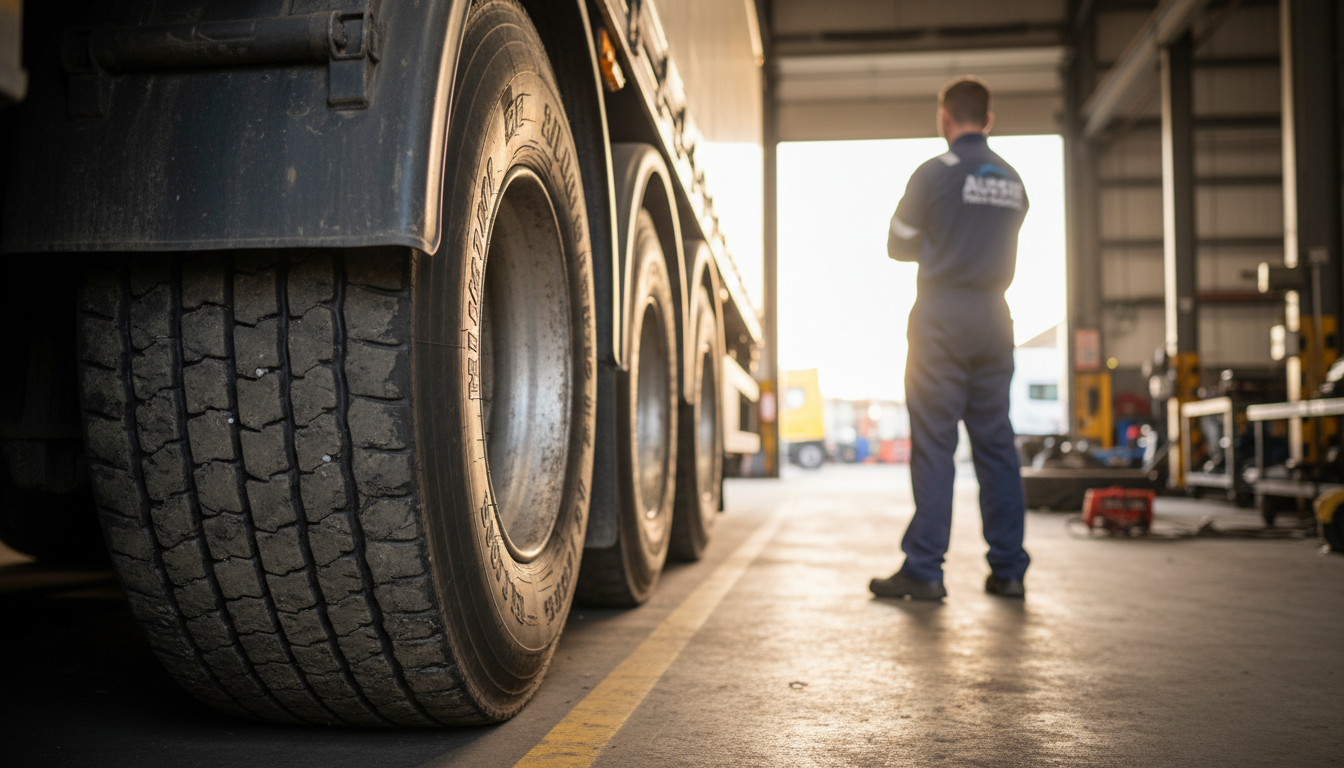
Identifying when truck tyres near end of life is a compliance obligation under the Heavy Vehicle National Law (HVNL), not a maintenance preference. Operating with defective tyres exposes transport operators to roadside defect notices during Transport for NSW inspections, Chain of Responsibility penalties, and increased crash risk. Tyre failure indicators include worn tread below legal minimums, age-related rubber degradation, sidewall damage exposing structural cords, and uneven wear patterns signalling mechanical faults. This diagnostic guide provides the technical measurements and inspection criteria required to determine when tyres must be replaced to maintain roadworthiness under National Heavy Vehicle Regulator (NHVR) standards.
Eagle Truck Centre has serviced Sydney’s heavy vehicle operators since 2015, responding to tyre failures across Greater Sydney with 24/7 mobile replacement services. Our technicians assess tyre condition on-site at depots and roadside locations, providing immediate replacement with Bridgestone, Dunlop, and Hankook tyres that meet load index and ply rating requirements for steer, drive, and trailer axle applications.
Industry Data
- —According to the Bureau of Infrastructure and Transport Research Economics (BITRE), tyre defects contribute to approximately 6% of heavy vehicle crashes in Australia, with worn or defective tyres identified as a critical roadworthiness factor.
- —Transport for NSW data indicates that tyre-related defects account for over 15% of all heavy vehicle defect notices issued during roadside inspections across NSW.
Minimum Legal Tread Depth Under Heavy Vehicle National Law
The Heavy Vehicle National Law (HVNL) establishes different minimum tread depth requirements based on axle position. Steer axle tyres must maintain a minimum tread depth of 1.6mm across the full width of the tread pattern. Drive axle and trailer axle tyres require a minimum of 1mm tread depth. These thresholds represent the absolute legal minimum — tyres measuring at or below these depths during a Transport for NSW roadside inspection will result in a defect notice.
Tread depth is measured using calibrated gauges at multiple points across the tyre width, focusing on the central three-quarters of the tread pattern where contact with the road surface occurs. The National Heavy Vehicle Regulator (NHVR) specifies that measurements must be taken in the principal grooves, not on tread wear indicator bars or raised sections. Fleet operators should implement replacement protocols when steer tyres reach 3mm and drive or trailer tyres reach 2mm to avoid operating at the legal threshold where sudden wear acceleration can push tyres below compliance standards between inspections.
Tyre Wear Indicators: Reading the Built-In Warning Signs
Tyre wear indicators (TWI bars) are raised sections moulded into the base of the principal grooves at 1.6mm height for passenger and steer tyres, and 1mm for commercial drive and trailer tyres. When the tread surface wears flush with these indicator bars, the tyre has reached its legal minimum tread depth and must be replaced immediately. TWI bar locations are marked on the tyre sidewall with triangular symbols, the letters “TWI”, or manufacturer-specific indicators positioned around the tyre circumference.
Visual inspection of TWI bars provides a quick field assessment during pre-trip inspections, but does not replace calibrated tread depth measurement for compliance documentation. Fleet operators should record tread depth measurements at regular intervals using digital or mechanical gauges, documenting readings for each tyre position. This creates an audit trail demonstrating due diligence under Chain of Responsibility obligations and provides early warning when tyres approach replacement thresholds. When tread is within 1mm of the TWI bar height, replacement planning should begin to avoid operational disruption from sudden tyre failure or defect notices during roadside inspections.
Uneven Wear Patterns and What They Indicate
Uneven tyre wear accelerates the approach to end-of-life status and indicates underlying mechanical or operational faults requiring correction. Centre tread wear with minimal shoulder wear indicates chronic over-inflation, where excessive pressure concentrates load on the central tread ribs. Edge or shoulder wear with preserved centre tread indicates under-inflation, allowing sidewall flex that increases shoulder contact pressure. One-sided wear across the tread width indicates alignment issues, camber misalignment, or suspension component wear requiring immediate mechanical assessment.
Cupping or scalloped wear patterns around the tyre circumference indicate suspension component wear, wheel bearing play, or balance issues causing the tyre to bounce during rotation. Feathering, where tread blocks show smooth wear on one edge and sharp edges on the other, indicates toe misalignment requiring wheel alignment and tyre wear correction. These patterns not only reduce tyre lifespan but create handling instability and increased rolling resistance. For detailed diagnostic context on abnormal wear identification, refer to our guide on understanding truck tyre wear patterns.
When uneven wear causes any section of the tyre to reach minimum tread depth while other sections retain adequate tread, the entire tyre must be replaced. The National Heavy Vehicle Regulator (NHVR) assesses tread depth at the most worn point, not the average across the tread width. Replacing tyres showing uneven wear without correcting the underlying mechanical fault will result in premature failure of replacement tyres, multiplying costs and downtime.
Sidewall Damage, Cracking, and Structural Integrity
Sidewall damage compromises tyre structural integrity regardless of remaining tread depth. Cuts, gouges, or abrasions deeper than 25mm or exposing tyre cords constitute immediate failure criteria under the Heavy Vehicle National Law (HVNL). Bulges or blisters on the sidewall indicate internal ply separation where the structural layers have detached, creating a weak point prone to catastrophic failure under load. These defects cannot be repaired and require immediate tyre replacement.
Sidewall cracking, particularly in the lower sidewall near the bead area, indicates rubber degradation from age, UV exposure, ozone damage, or chemical contamination. Fine surface crazing may not constitute an immediate safety risk, but deep cracks penetrating into the rubber compound or cracks that widen when the tyre is inflated indicate structural weakness requiring replacement. During Transport for NSW roadside inspections, authorised officers assess sidewall condition as part of the tyre roadworthiness evaluation, issuing defect notices for damage that compromises structural integrity.
Sidewall damage often results from kerb strikes, debris impact, or operating at incorrect inflation pressures. Maintaining correct tyre pressure (typically 8-9 bar for heavy vehicle applications depending on load and tyre specification) reduces sidewall flex and heat buildup that accelerates rubber degradation. Regular visual inspection of sidewalls during pre-trip checks allows early detection of damage before it progresses to failure-critical status.
Age-Related Degradation: When Tread Depth Isn’t the Only Factor
Tyre age determines end-of-life status independent of tread depth. The National Heavy Vehicle Regulator (NHVR) recommends replacing tyres after 10 years from the date of manufacture regardless of remaining tread, due to rubber compound degradation that reduces structural strength and increases failure risk. Tyre age is determined by the DOT code moulded into the sidewall — a four-digit number where the first two digits indicate the week of manufacture and the last two digits indicate the year. For example, DOT code 2318 indicates the tyre was manufactured in the 23rd week of 2018.
Rubber compounds degrade through oxidation, UV exposure, thermal cycling, and ozone exposure even when tyres are not in service. This degradation causes loss of elasticity, reduced tensile strength, and increased susceptibility to cracking and structural failure. Tyres stored outdoors or in direct sunlight age faster than those stored in climate-controlled facilities. Spare tyres carried on vehicles or stored in depot yards should be included in age-based replacement planning.
Fleet operators should implement replacement protocols for tyres reaching seven years of age, particularly for steer axle applications where sudden failure creates immediate control loss. While the 10-year threshold represents the absolute maximum service life, prudent risk management dictates earlier replacement for tyres in critical positions or operating in severe service conditions including high ambient temperatures, extended highway operation, or heavy load applications.
What Happens If You’re Caught with Defective Tyres During a Transport for NSW Inspection
Transport for NSW authorised officers conduct roadside inspections under the Heavy Vehicle National Law (HVNL), assessing tyre condition as part of roadworthiness evaluation. Tyres with tread depth below legal minimums, structural damage, or age-related degradation constitute defects requiring immediate rectification. Minor defects allow continued operation with a requirement to repair within a specified timeframe, typically 7 to 14 days. Major defects prevent the vehicle from being driven until tyres are replaced and the defect is cleared by an authorised inspection station or mobile service provider.
Penalties for operating with defective tyres range from on-the-spot fines to court-imposed sanctions depending on severity and whether the defect contributed to a crash or safety incident. Chain of Responsibility provisions under the Heavy Vehicle National Law (HVNL) extend liability beyond the driver to transport operators, schedulers, loaders, and consignors who should reasonably know the vehicle has defective tyres. This creates compliance obligations for all parties in the transport chain to verify tyre condition before dispatch.
When a defect notice is issued on the roadside, operators require immediate access to emergency mobile tyre replacement services to minimise downtime and restore the vehicle to roadworthy status. Eagle Truck Centre provides 24/7 mobile response across Greater Sydney, delivering and fitting replacement tyres at roadside locations to clear defect notices and return vehicles to service.
When to Replace vs When to Repair
Not all tyre damage requires replacement — repairable damage is limited to punctures in the tread area caused by nails, screws, or similar objects where the puncture diameter does not exceed 6mm and the damage has not compromised the sidewall or shoulder area. Repairs must be performed from the inside of the tyre using a combination patch and plug system that seals the puncture and reinforces the damaged area. Repairs to the sidewall, shoulder, or bead area are not permitted under industry standards due to the structural loads and flex these areas experience during operation.
Tyres with tread depth at or below legal minimums cannot be repaired regardless of puncture location — they must be replaced. Similarly, tyres showing structural damage including exposed cords, ply separation, bulges, or deep sidewall cuts require replacement. Age-related degradation with significant cracking or loss of rubber elasticity eliminates repair as an option even for otherwise repairable punctures, as the degraded rubber will not hold a repair patch reliably.
When assessment determines replacement is required, mobile truck tyre services provide immediate response without requiring the vehicle to limp to a service centre on a damaged tyre. Eagle Truck Centre’s mobile units carry Bridgestone, Dunlop, Hankook, Archilles, and Remington tyres in common sizes for steer, drive, and trailer axle applications, enabling on-site replacement at depots or roadside locations across Sydney.
How to Monitor Tyre Condition Between Inspections
The National Heavy Vehicle Regulator (NHVR) requires pre-trip inspections that include visual tyre checks for obvious damage, correct inflation, and absence of foreign objects lodged in the tread. These daily checks provide the first line of defence against operating with defective tyres, but do not replace detailed periodic inspections with calibrated measurement tools. Fleet operators should implement weekly detailed tyre inspections including tread depth measurement at multiple points across each tyre, sidewall examination for cracks or damage, and pressure checks using calibrated gauges.
Documentation of inspection findings satisfies Chain of Responsibility record-keeping requirements under the Heavy Vehicle National Law (HVNL) and provides evidence of due diligence in maintaining roadworthy vehicles. Inspection records should include tyre position, tread depth measurements, pressure readings, visual condition assessment, and any corrective actions taken. This data also enables trend analysis to predict when tyres will reach replacement thresholds, allowing proactive scheduling rather than reactive replacement after failure or defect notice.
Implementing regular tyre maintenance schedules reduces the incidence of unexpected failures and extends overall tyre lifespan through early detection of developing issues. Proactive strategies for extending truck tyre lifespan include maintaining correct inflation pressures, rotating tyres between positions to equalise wear, and addressing mechanical faults that cause uneven wear patterns.
- ✓
Measure tread depth at multiple points across each tyre using a calibrated gauge — record measurements below 3mm for replacement planning. - ✓
Inspect sidewalls for cracks, bulges, cuts deeper than 25mm, or exposed cords indicating structural failure. - ✓
Check tyre wear indicators (TWI bars) — if tread is flush with indicator bars, tyre has reached legal minimum. - ✓
Examine wear patterns: centre wear indicates over-inflation, edge wear indicates under-inflation, one-sided wear indicates alignment issues. - ✓
Verify tyre age using DOT code on sidewall — plan replacement for tyres approaching 7-10 years regardless of tread. - ✓
Document all findings with photos and measurements to satisfy Chain of Responsibility record-keeping requirements under HVNL.
Selecting Replacement Tyres That Meet Load Requirements
Replacement tyres must meet or exceed the load index and ply rating specifications of the original equipment tyres, as determined by the vehicle manufacturer’s placard requirements and the National Heavy Vehicle Regulator (NHVR) Mass, Dimension and Loading requirements. The load index is a numerical code indicating the maximum load capacity of the tyre at the specified inflation pressure. Ply rating indicates the tyre’s load-carrying capacity and structural strength, with higher ply ratings required for heavier axle loads.
Steer axle tyres require specific tread patterns designed for directional control and must never be fitted with retreaded or remoulded tyres due to the critical safety function of steering control. Drive axle tyres require aggressive tread patterns for traction, while trailer axle tyres prioritise even wear and fuel efficiency. Mixing tyre types, brands, or tread patterns on the same axle creates handling imbalances and uneven wear, reducing the service life of both tyres.
For guidance on selecting appropriate replacement tyres based on your fleet’s operational requirements, load profiles, and route conditions, refer to our detailed resource on choosing replacement truck tyres. Eagle Truck Centre stocks Bridgestone, Dunlop, Hankook, Archilles, and Remington tyres across the load index and ply rating spectrum required for steer, drive, and trailer axle applications, with technical support available to match tyre specifications to vehicle requirements and operating conditions.
Frequently Asked Questions
What is the minimum legal tread depth for truck tyres in NSW?
Under the Heavy Vehicle National Law (HVNL), steer axle tyres must have a minimum tread depth of 1.6mm across the full width of the tread. Drive and trailer axle tyres require 1mm minimum tread depth. Transport for NSW inspectors measure tread depth during roadworthiness inspections using calibrated gauges.
Can I still use truck tyres that are 10 years old if the tread is good?
The National Heavy Vehicle Regulator (NHVR) recommends replacing tyres after 10 years regardless of tread depth due to rubber degradation. Age-related cracking, loss of elasticity, and reduced structural integrity can cause sudden failure even when tread appears adequate. Check the DOT date code on the sidewall to determine tyre age.
What happens if my truck fails a tyre inspection on the roadside?
Transport for NSW authorised officers can issue a defect notice under the Heavy Vehicle National Law (HVNL) requiring immediate rectification. Major defects prevent the vehicle from being driven until tyres are replaced. Penalties range from on-the-spot fines to court-imposed sanctions depending on severity and whether the defect contributed to a safety risk.
How often should I check my truck tyres for wear indicators?
The National Heavy Vehicle Regulator (NHVR) requires pre-trip inspections that include visual tyre checks. Fleet operators should implement weekly detailed tyre inspections including tread depth measurement, sidewall examination, and pressure checks. Document all inspections to demonstrate compliance with Chain of Responsibility obligations under the Heavy Vehicle National Law (HVNL).
Eagle Truck Centre provides 24/7 mobile truck tyre replacement services across Sydney with Bridgestone, Dunlop, and Hankook tyres. Our technicians respond to roadside emergencies and conduct on-site tyre assessments at your depot. Contact our Smeaton Grange or Emu Plains locations for immediate tyre replacement services.
24/7 mobile roadside assistance. Three locations across South West and Western Sydney. Operating since 2015.