
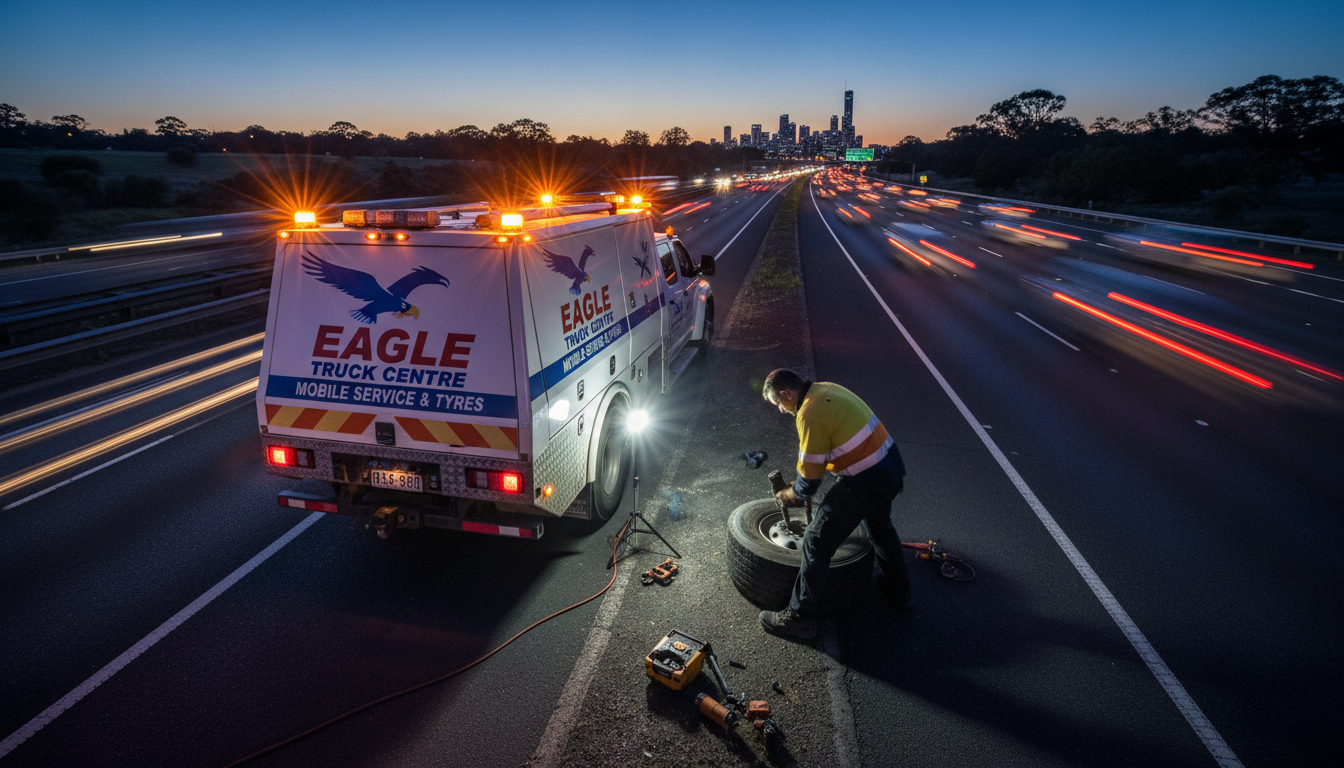
When a heavy vehicle tyre fails on a Sydney motorway or regional highway, the immediate question is not whether you need emergency truck tyre replacement, but how fast that service can actually reach you and get your vehicle roadworthy again. Under the Heavy Vehicle National Law (HVNL), operating a heavy vehicle with defective tyres constitutes a roadworthiness offence, making rapid replacement a legal and operational necessity. This guide explains the realistic timeframes, step-by-step process, and compliance requirements for emergency truck tyre replacement services across Greater Sydney.
The National Heavy Vehicle Regulator (NHVR) reports that tyre defects are among the most common roadworthiness failures detected during heavy vehicle inspections across Australia. When tyre failure occurs, the speed of your emergency response directly impacts downtime costs, delivery schedules, and compliance with chain of responsibility obligations. Understanding how mobile tyre replacement services actually work helps fleet managers and drivers set realistic expectations and minimise delays.
What Happens When You Call for Emergency Truck Tyre Replacement
The emergency truck tyre replacement process begins the moment you contact a mobile service provider. Your initial call triggers a dispatch sequence that determines response time and service capability. Reputable mobile tyre services will immediately request your exact location, vehicle configuration, tyre size, and a description of the failure to assess whether roadside replacement is feasible and which tyres to load onto the mobile unit.
During this initial contact, the service provider verifies critical information including your vehicle’s tyre placard specifications, load rating requirements under National Heavy Vehicle Regulator (NHVR) Mass, Dimension and Loading requirements, and whether the required tyre size and load index are currently in stock. This verification step prevents wasted response time and ensures the mobile unit arrives equipped with compliant replacement tyres. Knowing what to do when you’re stranded with a tyre failure before the emergency occurs significantly reduces total service time.
The dispatcher will also assess safety conditions at your location. If your vehicle is positioned dangerously or in a location where roadside work violates SafeWork NSW requirements for safe heavy vehicle maintenance, the service provider may advise repositioning the vehicle or arranging a controlled tow to a safer location before attempting tyre replacement.
Typical Response Times for Mobile Truck Tyre Services in Sydney
Response times for emergency truck tyre replacement in metro Sydney typically range from 60 to 90 minutes from initial call to technician arrival. This timeframe depends on several variables including the mobile unit’s current location, traffic conditions, distance from service depots, and whether the correct load-rated tyre is immediately available in the mobile inventory.
Eagle Truck Centre operates mobile units dispatched from Smeaton Grange NSW 2567 and Emu Plains NSW 2750, providing coverage across South West Sydney, Western Sydney, and Greater Sydney metro areas. Callouts within 30 kilometres of these depot locations during business hours typically achieve response times at the lower end of the 60–90 minute range, while overnight callouts or regional locations may extend toward 90 minutes or longer depending on technician availability and travel distance.
According to Transport for NSW (TfNSW), heavy vehicle breakdowns on major arterial roads create significant traffic disruption and safety risks, with tyre failures representing a substantial proportion of roadside incidents. This operational reality makes response time a critical service metric. However, drivers and fleet managers should understand that the fastest response time means nothing if the arriving technician lacks the correct tyre specification or load rating to maintain NHVR compliance.
Once the mobile unit arrives on site, the actual tyre replacement process takes 30 to 45 minutes for a single tyre on a standard rigid truck or semi-trailer configuration. Multi-axle replacements, dual tyre assemblies, or complex trailer configurations extend this timeframe. The total elapsed time from initial call to completion typically ranges from 90 minutes to two hours for straightforward single-tyre replacements in accessible metro locations.
The Step-by-Step Emergency Tyre Replacement Process
Understanding the sequential steps involved in emergency truck tyre replacement helps drivers and fleet managers recognise what constitutes professional service and where delays might occur. The process follows a standardised sequence designed to maintain safety and regulatory compliance.
- 01
Site Safety AssessmentUpon arrival, the mobile technician assesses the worksite for hazards, verifies the vehicle is safely positioned off the carriageway, and establishes a safe work zone with warning signage and traffic management equipment as required under SafeWork NSW regulations for roadside heavy vehicle maintenance.
- 02
Tyre Placard VerificationThe technician photographs and verifies the vehicle’s tyre placard specifications including required load index, speed rating, and tyre size for the affected axle position. This verification ensures the replacement tyre meets National Heavy Vehicle Regulator (NHVR) Mass, Dimension and Loading requirements and maintains the vehicle’s roadworthiness certification under the Heavy Vehicle National Law (HVNL).
- 03
Vehicle Stabilisation and JackingThe technician positions heavy-duty jacks rated for the vehicle’s axle mass, applies wheel chocks to prevent movement, and ensures the vehicle is stable before loosening wheel nuts. Mobile units carry pneumatic or hydraulic jacking equipment suitable for heavy vehicle axle loads ranging from 6 to 10 tonnes per axle depending on vehicle configuration.
- 04
Failed Tyre RemovalUsing impact wrenches and appropriate socket sizes for heavy vehicle wheel nuts, the technician removes the failed tyre assembly. For dual tyre configurations, both tyres on the affected wheel position are typically inspected and may require replacement to maintain matched tread depth and rolling circumference as recommended by tyre manufacturers.
- 05
Wheel Hub and Stud InspectionBefore installing the replacement tyre, the technician inspects wheel studs for damage, checks hub surfaces for corrosion or debris, and verifies brake components are not damaged. This inspection step identifies secondary issues that could compromise the replacement tyre’s performance or create additional roadworthiness defects.
- 06
Replacement Tyre InstallationThe technician mounts the replacement tyre, ensuring correct directional orientation for directional tread patterns and verifying the load index and speed rating markings match placard requirements. Wheel nuts are torqued to manufacturer specifications, typically 450–650 Nm for heavy vehicle applications depending on stud size and wheel type.
- 07
Tyre Pressure AdjustmentThe replacement tyre is inflated to the pressure specified on the vehicle’s tyre placard, typically 8.0 to 9.0 bar for steer axle tyres and 8.5 to 9.5 bar for drive axle tyres on standard rigid trucks and semi-trailers. Mobile units carry portable air compressors capable of inflating heavy vehicle tyres to these pressures measured in bar or kilopascals (kPa).
- 08
Final Inspection and DocumentationThe technician performs a final visual inspection, verifies wheel nut torque, and provides documentation including tyre brand, size, load index, speed rating, and installation date for the operator’s maintenance records. This documentation supports compliance with chain of responsibility record-keeping obligations under the Heavy Vehicle National Law (HVNL).
This eight-step process typically requires 30 to 45 minutes for experienced technicians working on accessible single-tyre replacements. Complex configurations, seized wheel nuts, or damaged wheel components extend this timeframe.
Mobile Service vs Workshop Tow: Which Is Faster?
When comparing emergency response options, mobile tyre services versus workshop repairs present significantly different timeframes and cost structures. Mobile emergency truck tyre replacement eliminates towing time, towing costs, and workshop queue delays that can extend total downtime from hours to days depending on workshop capacity and tow truck availability.
A typical tow-to-workshop scenario involves calling a heavy vehicle tow service, waiting 60 to 90 minutes for tow truck arrival, spending 30 to 60 minutes on the tow itself depending on distance to the nearest workshop, then joining the workshop’s service queue which may involve overnight or multi-day delays during peak periods. Total elapsed time from breakdown to roadworthy vehicle frequently exceeds 24 hours and can reach several days for regional breakdowns requiring long-distance towing.
In contrast, mobile truck tyre repair services bring the workshop to your location, completing the entire service in 90 minutes to two hours from initial call to completion for straightforward replacements. This time advantage translates directly to reduced downtime costs, faster return to service, and minimised delivery schedule disruption.
Mobile service also eliminates the safety risks associated with towing damaged heavy vehicles through traffic. Under the Heavy Vehicle National Law (HVNL), operators remain responsible for ensuring towed vehicles do not create additional safety hazards, and towing a vehicle with catastrophic tyre failure may require specialised equipment and permits depending on the extent of damage and towing distance.
The primary limitation of mobile service is tyre inventory. Workshop facilities stock broader tyre size ranges and specialty configurations, while mobile units carry common sizes in popular load ratings. If your vehicle requires an uncommon tyre size or specialty application, workshop service may be necessary despite the longer timeframe.
What Factors Affect Emergency Tyre Replacement Speed
Several operational and logistical factors determine actual response and service times for emergency truck tyre replacement. Understanding these variables helps fleet managers set realistic expectations and identify service providers capable of meeting urgent timeframes.
Geographic location represents the primary determinant of response time. Breakdowns within 20 to 30 kilometres of mobile service depots achieve faster response than regional highway locations requiring 60 to 90 minutes of travel time. Eagle Truck Centre’s depot locations at Smeaton Grange NSW 2567 and Emu Plains NSW 2750 provide strategic coverage across South West Sydney and Western Sydney, but callouts to the Central Coast, Southern Highlands, or Blue Mountains regions naturally require extended travel time.
Tyre availability directly impacts service speed. Mobile units stock common heavy vehicle tyre sizes including 295/80R22.5, 315/80R22.5, and 385/65R22.5 in popular load ratings, but specialty sizes or less common load indices may require sourcing from depot inventory or supplier networks. Confirming tyre availability during the initial call prevents wasted response time when the mobile unit arrives without the correct specification.
Time of day and traffic conditions affect travel time to the breakdown location. Peak hour callouts in metro Sydney areas can add 20 to 40 minutes to response time compared to off-peak travel. Overnight callouts between 10pm and 6am typically achieve faster travel times but may involve technician callout delays depending on staffing arrangements and 24/7 service capability.
Vehicle configuration and accessibility influence the actual replacement process duration. Standard rigid trucks and semi-trailers with accessible wheel positions allow faster service than B-doubles with inner axle failures, tri-axle configurations requiring multiple tyre replacements, or vehicles positioned in locations with limited working space. Dual tyre assemblies require longer service time than single tyre positions due to the need to remove and inspect both tyres.
Weather conditions and site safety factors can extend service time or make roadside replacement inadvisable. Heavy rain, high winds, or dangerous traffic conditions may require relocating the vehicle to a safer position before commencing work, adding time to the overall service duration but maintaining compliance with SafeWork NSW safety requirements.
Can All Tyre Failures Be Repaired Roadside?
Not all tyre failures are suitable for roadside repair, and understanding the distinction between repairable and replacement-only failures helps drivers and fleet managers make informed decisions during emergency callouts. Recognising signs your truck tyre needs replacement before catastrophic failure occurs reduces the likelihood of emergency situations.
Repairable tyre failures typically involve punctures in the tread area caused by nails, screws, or road debris, provided the puncture diameter does not exceed 6mm and the tyre’s internal structure remains intact. Understanding emergency tyre repair fundamentals helps drivers assess whether repair is feasible before calling for service. Mobile technicians carry plug and patch repair equipment for these scenarios, completing repairs in 20 to 30 minutes when conditions permit.
Replacement-only failures include sidewall damage, tread separation, impact breaks, tyres worn below the legal minimum tread depth of 1.5mm, tyres with exposed cords or belts, and tyres that have been run flat for any distance. These failure modes compromise the tyre’s structural integrity and cannot be safely repaired under industry standards or manufacturer guidelines. Operating a heavy vehicle with these tyre conditions constitutes a roadworthiness offence under the Heavy Vehicle National Law (HVNL).
Blowouts caused by under-inflation, overloading, or impact damage typically result in catastrophic structural failure requiring immediate replacement. Mobile emergency services can replace these tyres roadside provided the wheel rim and hub components remain undamaged. If the blowout has damaged brake lines, suspension components, or wheel rims, the vehicle may require towing to workshop facilities for comprehensive repair beyond tyre replacement alone.
Tyre age also factors into replacement decisions. Tyres exceeding seven years from manufacture date should be replaced regardless of tread depth, as rubber compound degradation reduces structural integrity even when visual wear appears minimal. Mobile technicians check the tyre’s DOT date code during assessment to identify age-related replacement requirements.
Load Rating and Tyre Specification Verification During Emergency Service
Compliance with National Heavy Vehicle Regulator (NHVR) Mass, Dimension and Loading requirements mandates that replacement tyres match or exceed the load index and speed rating specified on the vehicle’s tyre placard. This verification process is non-negotiable during emergency truck tyre replacement and directly impacts the vehicle’s legal roadworthiness under the Heavy Vehicle National Law (HVNL).
Every heavy vehicle displays a tyre placard specifying the minimum load index for each axle position. Steer axle tyres typically require load indices of 146 to 152 depending on vehicle configuration, representing load capacities of 2,500kg to 3,350kg per tyre at maximum inflation pressure. Drive axle tyres and trailer tyres may require different load indices based on the vehicle’s gross vehicle mass and axle mass distribution.
Mobile technicians verify these specifications before installing replacement tyres by photographing the vehicle’s placard and cross-referencing the replacement tyre’s sidewall markings. The load index appears as a numerical code following the tyre size designation, such as 295/80R22.5 152/148M, where 152 represents the load index for single fitment and 148 for dual fitment, and M indicates the speed rating.
Installing a tyre with insufficient load rating creates a chain of responsibility compliance breach, as the vehicle no longer meets its certification requirements and the operator, driver, and service provider may all face penalties under the Heavy Vehicle National Law (HVNL). Reputable mobile services refuse to install non-compliant tyres regardless of urgency or customer pressure, as the legal and safety consequences outweigh any time-saving benefit.
Eagle Truck Centre maintains detailed records of tyre placard specifications for regular fleet customers, streamlining the verification process during emergency callouts. For new customers, technicians photograph and document placard information during the service, creating a reference for future maintenance and emergency situations.
Speed rating verification is equally important, though less commonly problematic for heavy vehicles. Most heavy vehicle tyres carry J-rating (100 km/h) or K-rating (110 km/h) speed categories, matching the speed limiter requirements for heavy vehicles operating under NHVR regulations. Replacement tyres must meet or exceed the placard-specified speed rating to maintain roadworthiness certification.
How to Minimise Emergency Tyre Replacement Delays
Drivers and fleet managers can take specific actions to reduce response time and service duration during emergency truck tyre replacement situations. Preparation before emergencies occur and correct procedures during the event significantly impact total downtime.
- ✓
Confirm your exact location and nearest cross-street or kilometre marker when calling for emergency service - ✓
Have your vehicle registration and tyre placard information ready to verify correct load rating requirements - ✓
Ensure your vehicle is positioned safely off the carriageway with hazard lights activated and warning triangles deployed - ✓
Confirm the mobile service carries the correct tyre size, load index, and speed rating for your vehicle configuration - ✓
Request verification that replacement tyres meet National Heavy Vehicle Regulator (NHVR) specifications before installation - ✓
Obtain documentation of the tyre replacement including load rating, brand, and date for your maintenance records
Maintaining accurate tyre placard information in your vehicle’s documentation folder or fleet management system eliminates verification delays during emergency callouts. Photographing the placard and storing the image in your phone or fleet management app provides immediate reference when calling for service.
Establishing a relationship with a mobile tyre service provider before emergencies occur streamlines the response process. Pre-registered fleet customers benefit from stored vehicle specifications, preferred tyre brands, and priority dispatch during high-demand periods. Eagle Truck Centre has serviced Sydney’s heavy vehicle operators since 2015, building detailed fleet profiles that accelerate emergency response for regular customers.
Implementing preventive maintenance strategies including regular tyre pressure checks, tread depth monitoring, and scheduled tyre rotations reduces the frequency of emergency situations. While emergency services remain necessary for unpredictable failures, proactive maintenance minimises the proportion of tyre failures requiring urgent roadside replacement.
Driver training on correct emergency procedures also impacts service speed. Drivers who position vehicles safely, deploy warning equipment correctly, and provide accurate information during the initial call enable faster, safer service. Fleet managers should include emergency breakdown procedures in driver induction and refresher training programs.
Eagle Truck Centre’s 24/7 Emergency Mobile Tyre Service
Eagle Truck Centre operates 24/7 emergency mobile truck tyre replacement services across Greater Sydney, with mobile units dispatched from depot locations at 79 Hartley Rd, Smeaton Grange NSW 2567 and 104 Russell St, Emu Plains NSW 2750. Our mobile units carry Bridgestone, Dunlop, Hankook, Achilles, and Remington tyres in common heavy vehicle sizes including 295/80R22.5, 315/80R22.5, and 385/65R22.5 in load ratings from 146 to 156 to suit most rigid trucks, semi-trailers, and B-double configurations.
Response times for metro Sydney callouts typically range from 60 to 90 minutes depending on location and traffic conditions. Our technicians verify load ratings against National Heavy Vehicle Regulator (NHVR) requirements before every installation, ensuring replacement tyres maintain your vehicle’s roadworthiness certification under the Heavy Vehicle National Law (HVNL). We provide detailed documentation including tyre specifications, load ratings, installation date, and technician details for your maintenance records and chain of responsibility compliance obligations.
Our mobile units carry pneumatic jacking equipment, impact wrenches, torque wrenches calibrated to heavy vehicle specifications, and portable air compressors capable of inflating tyres to 8.0 to 9.5 bar pressures required for heavy vehicle applications. Technicians complete site safety assessments before commencing work and maintain compliance with SafeWork NSW requirements for roadside heavy vehicle maintenance.
For fleet customers, we maintain detailed vehicle profiles including tyre placard specifications, preferred tyre brands, and service history, enabling faster response during emergency callouts. Our 10-plus years servicing Sydney’s heavy vehicle operators since 2015 has built expertise across diverse vehicle configurations and operational requirements, from local delivery trucks to interstate transport fleets.
Emergency Service Coverage
- —24/7 mobile emergency tyre replacement across South West Sydney, Western Sydney, and Greater Sydney metro areas
- —Response times typically 60–90 minutes for metro Sydney locations within 30km of Smeaton Grange or Emu Plains depots
- —Mobile units stocked with common heavy vehicle tyre sizes in load ratings 146–156 from Bridgestone, Dunlop, Hankook, Achilles, and Remington
While emergency services address immediate breakdowns, implementing regular tyre maintenance for commercial trucks reduces the frequency and severity of tyre failures requiring urgent response. Our workshop facilities at Smeaton Grange and Emu Plains provide scheduled tyre inspections, rotations, and replacements during planned maintenance windows, minimising unplanned downtime and emergency service costs.
Frequently Asked Questions
How long does emergency truck tyre replacement actually take?
From initial call to completion, emergency truck tyre replacement typically takes 60–90 minutes in metro Sydney areas, depending on location and tyre availability. The actual roadside replacement process takes 30–45 minutes once the mobile service arrives. Response time depends on traffic conditions, distance from the service depot, and whether the correct load-rated tyre is in stock.
Can mobile tyre services replace tyres on all heavy vehicle types?
Mobile emergency tyre services can replace tyres on most rigid trucks, semi-trailers, and B-doubles, provided the vehicle is safely positioned and the mobile unit carries the correct tyre size and load rating. Specialised heavy haulage tyres or oversized configurations may require workshop facilities. The National Heavy Vehicle Regulator (NHVR) requires replacement tyres meet the vehicle’s placard specifications for load rating and speed category.
What should I do while waiting for emergency tyre replacement?
Position your vehicle safely off the carriageway if possible, activate hazard lights, and deploy warning triangles as required under the Heavy Vehicle National Law (HVNL). Do not attempt to change the tyre yourself unless you have proper training and equipment—SafeWork NSW regulations require appropriate safety procedures for roadside heavy vehicle maintenance. Remain in a safe location away from traffic.
Are emergency tyre replacements compliant with NHVR requirements?
Yes, reputable mobile tyre services verify load rating, speed rating, and tyre specifications against the vehicle’s placard before installation, ensuring compliance with National Heavy Vehicle Regulator (NHVR) Mass, Dimension and Loading requirements. The replacement tyre must match or exceed the original equipment specifications. Operators remain responsible for ensuring the replacement maintains roadworthiness under the Heavy Vehicle National Law (HVNL).
Is 24/7 emergency truck tyre replacement available in Western Sydney?
Eagle Truck Centre provides 24/7 emergency mobile truck tyre replacement across Western Sydney and South West Sydney, with mobile units dispatched from Smeaton Grange and Emu Plains locations. Response times vary by location and time of day, but metro Sydney callouts typically receive service within 60–90 minutes. Stock availability of specific tyre sizes and load ratings affects service speed.
Eagle Truck Centre provides 24/7 emergency mobile truck tyre replacement across Sydney with response times typically under 90 minutes. Our mobile units carry Bridgestone, Dunlop, Hankook, Achilles, and Remington tyres in common heavy vehicle sizes, and we verify load ratings against NHVR requirements before every installation. Contact us now for immediate roadside assistance.
24/7 mobile roadside assistance. Three locations across South West and Western Sydney. Operating since 2015.