
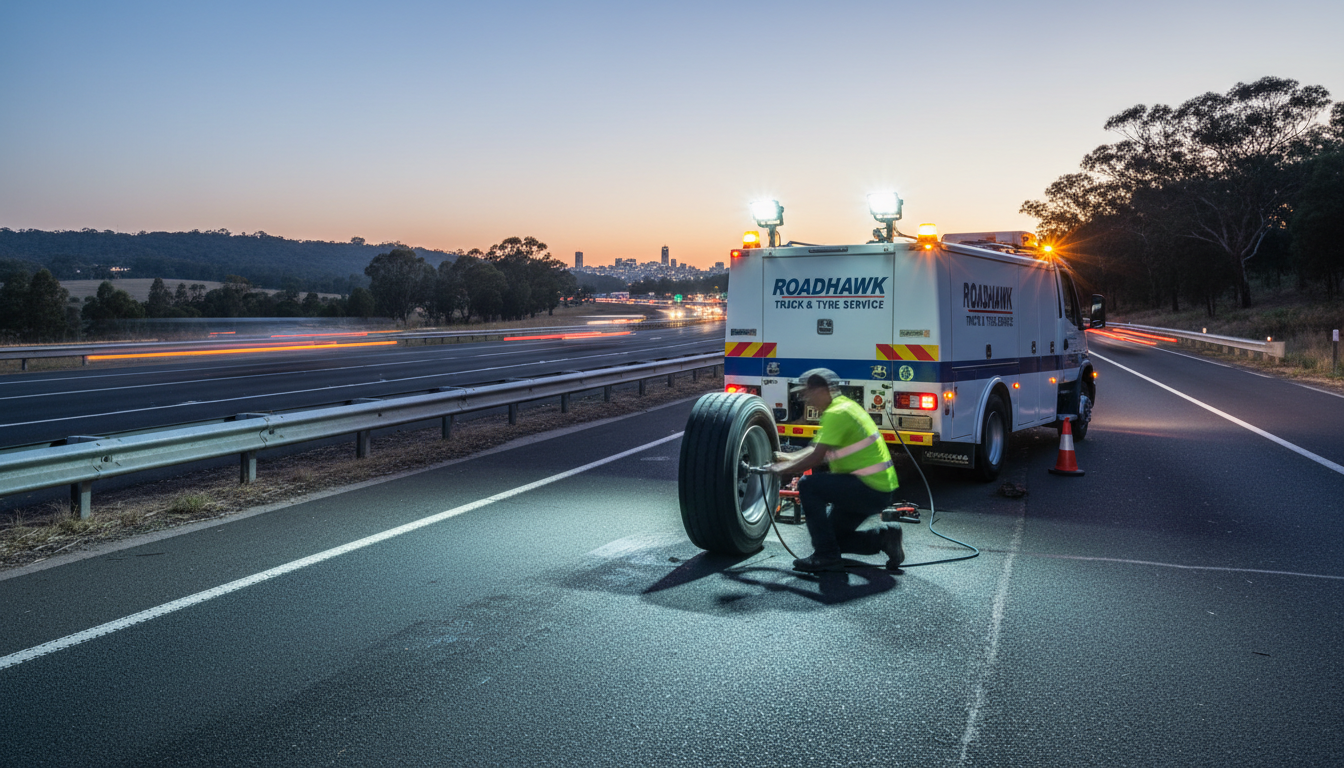
You are 40 kilometres from your depot when the steering pulls hard left and the low-pressure warning sounds. A roadside truck tyre emergency has just begun. What happens next depends on how quickly you can secure the scene, contact professional assistance, and provide the information needed for fast dispatch. This guide walks transport operators through the complete process of a roadside truck tyre emergency call, from initial contact through to compliance documentation, based on procedures refined over 10 years of 24/7 mobile service across Greater Sydney.
Tyre failures account for approximately 6% of heavy vehicle breakdowns on Australian roads, according to Bureau of Infrastructure and Transport Research Economics (BITRE) heavy vehicle monitoring data. Transport for NSW (TfNSW) enforcement data shows that defective tyres are among the top three defects identified during roadside heavy vehicle inspections, with penalties ranging from $349 to $3,740 depending on severity. Understanding the emergency response process reduces downtime, ensures compliance with the Heavy Vehicle National Law (HVNL), and protects drivers working in high-risk roadside environments.
Step 1: Making the Emergency Call — Information You’ll Need to Provide
The quality of information provided during your initial call directly affects dispatch speed and whether the service vehicle arrives with the correct tyre. Before calling for emergency mobile tyre replacement procedures, gather the following details:
- Exact location: Nearest kilometre marker, cross street, or GPS coordinates. “Somewhere on the M7” delays dispatch by 20-40 minutes.
- Vehicle registration and fleet number: Required for service records and invoicing.
- Tyre position: Steer axle, drive axle, or trailer. Single or dual configuration.
- Tyre size: Found on the sidewall (e.g., 295/80R22.5, 11R22.5). If unreadable due to damage, provide vehicle make and axle type.
- Nature of failure: Puncture, sidewall blowout, tread separation, or slow leak.
- Load status: Empty, partial, or full load. Affects jack requirements and whether the vehicle can be safely lifted.
- Road conditions: Sealed shoulder, gravel verge, or no safe pull-off area. Determines traffic management requirements under the Work Health and Safety Act 2011 (NSW).
Professional mobile services use this information to confirm tyre stock availability, dispatch the appropriate service vehicle, and advise on safety setup requirements before arrival. Eagle Truck Centre’s dispatch system cross-references tyre sizes against current stock of Bridgestone, Dunlop, and Hankook tyres in common heavy vehicle specifications, providing immediate confirmation of availability and estimated arrival time.
Step 2: Service Vehicle Dispatch and ETA Confirmation
Once dispatch confirms the call, you receive an estimated time of arrival based on current traffic conditions and the technician’s location. Mobile truck tyre services operating across Western Sydney typically provide ETAs within 45-90 minutes for locations between Smeaton Grange, Emu Plains, and the Sydney CBD, depending on time of day and motorway access.
The service vehicle carries:
- Hydraulic jacks rated for heavy vehicle axle loads (typically 10-20 tonne capacity)
- Torque wrenches calibrated to manufacturer specifications (450-650 Nm for most heavy vehicle wheel nuts)
- Tyre pressure inflation equipment accurate to 0.1 bar
- Stock tyres in common sizes: 295/80R22.5, 315/80R22.5, 11R22.5, 385/65R22.5
- Safety equipment including warning triangles, high-visibility clothing, and wheel chocks
- Diagnostic tools for assessing rim damage, brake system integrity, and bearing condition
During transit, the technician may contact you again to confirm vehicle positioning, request additional safety measures, or update the ETA if traffic conditions change. Use this time to complete the safety setup described in the next step.
Step 3: Roadside Safety Setup Under Work Health and Safety Act 2011 (NSW)
Before the technician arrives, the driver must establish a safe work zone. Under the Work Health and Safety Act 2011 (NSW), the person conducting a business or undertaking (PCBU) — which includes transport operators — has a duty to ensure the safety of workers, including contractors performing roadside repairs. SafeWork NSW guidelines for roadside work zones specify minimum requirements based on road type and traffic speed.
- 01
Position the vehicle as far left as safely possibleIf a sealed shoulder exists, move completely off the traffic lane. On roads without shoulders, activate hazard lights and remain in the vehicle until the service vehicle arrives with additional traffic management equipment.
- 02
Deploy warning trianglesPlace triangles 50 metres behind the vehicle on low-speed roads (up to 80 km/h) or 200 metres on high-speed roads. Position triangles in the line of sight of approaching traffic, not on the shoulder where they may be missed.
- 03
Apply wheel chocksChock wheels on the opposite side of the vehicle from the failed tyre. For drive axle or trailer failures, chock at least two wheels to prevent vehicle movement during jacking.
- 04
Wear high-visibility clothingAll personnel near the vehicle must wear clothing meeting AS/NZS 4602.1:2011 Class D/N standard, which provides visibility in both daylight and night conditions through reflective tape.
On high-speed motorways or roads without adequate shoulders, SafeWork NSW recommends remaining in the vehicle with seatbelts fastened until the service vehicle arrives. Professional mobile services carry additional traffic management equipment including portable warning signs and, where necessary, can arrange police or traffic management contractor attendance for high-risk locations.
Step 4: On-Site Safety Assessment and Vehicle Positioning
Upon arrival, the technician conducts a site safety assessment before beginning any repair work. This assessment follows emergency tyre repair protocols developed to comply with SafeWork NSW requirements for roadside work zones and protect both the technician and the driver.
The assessment includes:
- Traffic flow evaluation: Speed, volume, and proximity of passing vehicles. High-risk sites may require additional warning signage or repositioning the service vehicle to create a buffer zone.
- Ground stability: Soft verges, gravel shoulders, or uneven surfaces affect jack placement and stability. Unstable ground may require steel plates under jacks to distribute load.
- Vehicle stability: Load distribution, suspension condition, and whether the vehicle can be safely lifted. Overloaded vehicles or those with damaged suspension may require partial unloading before tyre replacement.
- Weather conditions: Rain, wind, or reduced visibility affect both safety and the time required to complete repairs. Severe weather may necessitate arranging a tow to a workshop rather than attempting roadside replacement.
If the site assessment identifies unacceptable risks, the technician will recommend alternative options including arranging a tow truck to move the vehicle to a safer location or a workshop facility. This decision prioritises compliance with the Work Health and Safety Act 2011 (NSW) duty of care obligations over speed of repair.
Step 5: Tyre Damage Inspection and Replacement Decision
Once the site is secured, the technician inspects the failed tyre to determine whether repair or replacement is required. Under the Heavy Vehicle National Law (HVNL), tyres must meet minimum roadworthiness standards including tread depth of at least 1.5mm across the full width of the tread, no exposed cords or fabric, and no cuts or damage that expose the tyre structure.
Damage types and replacement requirements:
- Punctures in the tread area: May be repairable if the puncture is less than 6mm diameter, located in the central three-quarters of the tread, and the tyre has not been run flat. Repairs must follow AS 1973:2005 standards for tyre repairs.
- Sidewall damage: Always requires replacement. Sidewall repairs are prohibited under industry standards due to structural integrity concerns and the high flexing forces sidewalls experience during operation.
- Tread separation: Requires replacement. Indicates internal structural failure that cannot be repaired and poses a high risk of complete failure.
- Multiple punctures: Tyres with more than two repairs, or repairs within 150mm of each other, must be replaced under AS 1973:2005.
- Run-flat damage: Any tyre operated while deflated must be replaced. Running flat causes internal carcass damage that is not visible externally but compromises structural integrity.
The technician also inspects the wheel rim for damage, checks brake components visible through the wheel, and examines adjacent tyres on the same axle for matching wear patterns or damage requiring attention. This comprehensive inspection ensures compliance with National Heavy Vehicle Regulator (NHVR) roadworthiness standards and identifies potential issues before they cause additional breakdowns.
Step 6: Tyre Replacement and Load Rating Verification
When replacement is required, the technician verifies that the replacement tyre matches the load index, speed rating, and size specifications of the original equipment or the vehicle manufacturer’s approved alternatives. This verification is critical for compliance with National Heavy Vehicle Regulator (NHVR) Mass, Dimension and Loading requirements, which mandate that tyres must be capable of carrying the axle loads under which the vehicle operates.
The benefits of mobile tyre repair include immediate access to correctly specified tyres without the delay and cost of towing. Professional services stock major brands in common specifications:
- Steer axle tyres: Typically 295/80R22.5 or 315/80R22.5 with load index 152/148 (3,550 kg per tyre at maximum pressure). Steer tyres must be new or near-new with no repairs, as steering failures pose the highest safety risk.
- Drive axle tyres: Common sizes include 11R22.5 and 295/80R22.5 with load index 146/143 (2,900 kg per tyre). Drive tyres may be fitted with retread product if the casing meets AS 1973:2005 standards.
- Trailer tyres: Sizes vary widely but 385/65R22.5 (load index 160) and 425/65R22.5 (load index 165) are common for tri-axle trailers carrying maximum GCM loads.
The replacement process follows manufacturer torque specifications, typically 450-650 Nm for heavy vehicle wheel nuts depending on stud size and wheel type. Under-torquing risks wheel detachment; over-torquing can damage studs or wheels. Professional technicians use calibrated torque wrenches and follow a star pattern tightening sequence to ensure even load distribution across all wheel nuts.
For dual tyre configurations, the technician checks that both tyres on the axle end are properly matched for diameter and inflation pressure. Mismatched dual tyres cause uneven load sharing, accelerated wear, and increased risk of failure on the overloaded tyre.
Step 7: Pressure Setting to NHVR Mass, Dimension and Loading Requirements
After installation, the replacement tyre is inflated to the pressure specified by the vehicle manufacturer for the actual load being carried. Under National Heavy Vehicle Regulator (NHVR) Mass, Dimension and Loading requirements, tyre pressures must be sufficient to support the axle mass at the operating speed. Insufficient pressure reduces load capacity, increases heat generation, and accelerates structural degradation.
Typical pressure ranges for heavy vehicle tyres:
- Steer axle: 8.0-9.0 bar (800-900 kPa) for single tyres on vehicles operating at maximum front axle mass
- Drive axle: 8.5-9.0 bar (850-900 kPa) for dual tyres on prime movers operating at maximum drive axle mass
- Trailer axles: 8.0-8.5 bar (800-850 kPa) for dual tyres on tri-axle trailers, adjusted based on actual load distribution
The technician uses calibrated pressure gauges accurate to 0.1 bar and cross-references the vehicle’s tyre placard or manufacturer specifications. For vehicles operating under Intelligent Access Program (IAP) or Higher Mass Limits (HML) permits, tyre pressures must meet the higher standards specified in the permit conditions.
After inflation, the technician checks all other tyres on the vehicle for correct pressure, as tyre failures often indicate broader maintenance issues affecting multiple tyres. This comprehensive check reduces the risk of additional failures during the remainder of the journey.
Step 8: Post-Repair Documentation and Compliance Records
Before the service vehicle departs, the technician provides documentation detailing the work completed. This documentation serves multiple purposes: it creates a maintenance record for fleet management systems, provides evidence of compliance with Heavy Vehicle National Law (HVNL) roadworthiness obligations, and may be required during Transport for NSW Heavy Vehicle Inspection Scheme assessments.
Essential documentation includes:
- Tyre specifications: Size, load index, speed rating, and brand. For example: “295/80R22.5 152/148M Bridgestone R249 Ecopia”.
- Installation details: Axle position (e.g., “steer axle left”), torque setting applied (e.g., “550 Nm”), and inflation pressure set (e.g., “8.5 bar / 850 kPa”).
- Date and time of service: Required for maintenance interval tracking and warranty claims.
- Technician identification: Name and service provider details for quality assurance and follow-up contact.
- Recommendations: Any additional tyres requiring attention, wheel alignment issues observed, or follow-up inspections required.
Many operators photograph the tyre sidewall showing size and load rating, the vehicle’s tyre placard, and the installed tyre on the vehicle. These photographs provide additional evidence of correct specification matching if questions arise during compliance inspections.
The technician also provides guidance on follow-up actions, typically including a torque check after 50-100 kilometres of operation and a full tyre inspection within 500 kilometres to verify pressure retention and identify any issues with the replacement or adjacent tyres.
When Mobile Service Is the Right Choice vs Towing to Workshop
Not every roadside tyre failure is suitable for mobile service. Understanding when mobile services versus workshop repairs are appropriate reduces costs and ensures safe outcomes.
Mobile service is appropriate when:
- The vehicle is positioned safely off the traffic lane with adequate shoulder width for technician access
- The failure is limited to tyre damage with no rim, brake, or suspension damage evident
- Ground conditions are stable enough to safely support hydraulic jacks
- The replacement tyre size and specification is available in mobile stock
- Weather conditions allow safe roadside work
Workshop service via tow truck is required when:
- The vehicle is in a live traffic lane on a high-speed road with no safe pull-off area
- Multiple tyres have failed, indicating a broader mechanical issue requiring diagnosis
- Rim damage, brake damage, or suspension damage is evident and requires workshop equipment to repair
- The required tyre size is not available in mobile stock and cannot be sourced within a reasonable timeframe
- Ground conditions are too soft or unstable to safely support jacking operations
Professional mobile services provide honest assessments of site suitability and will recommend towing when roadside repair poses unacceptable safety risks. Eagle Truck Centre maintains relationships with heavy vehicle towing operators across Western Sydney and can arrange transport to workshop facilities at Smeaton Grange or Emu Plains when required.
Preventing Future Roadside Emergencies Through Scheduled Maintenance
While roadside tyre failures cannot be eliminated entirely, regular tyre maintenance schedules reduce their frequency significantly. Operators who implement systematic inspection and maintenance programs experience fewer breakdowns, lower total tyre costs, and improved compliance with Heavy Vehicle National Law (HVNL) roadworthiness obligations.
Effective preventive maintenance includes:
- Weekly pressure checks: Conducted when tyres are cold, using calibrated gauges. Pressure loss exceeding 5% per week indicates a slow leak requiring investigation.
- Pre-trip visual inspections: Required under HVNL before each journey, checking for cuts, bulges, embedded objects, and tread depth. Drivers should know tyre wear patterns that indicate replacement needs before failures occur on the road.
- Monthly detailed inspections: Conducted by qualified personnel, including tread depth measurement across the full tyre width, pressure adjustment to manufacturer specifications, and documentation of findings.
- Quarterly wheel alignment checks: Misalignment causes rapid, uneven wear and increases the risk of sudden tread separation. Alignment should be checked whenever irregular wear patterns appear.
- Annual comprehensive assessments: Including removal and internal inspection of tyres showing external damage, replacement of tyres approaching minimum tread depth, and rotation where appropriate to equalise wear.
Operators should also maintain records of tyre purchase dates, installation dates, and removal reasons. This data identifies patterns such as premature wear on specific axle positions, recurring damage types, or tyres consistently failing before expected service life. These patterns often indicate correctable mechanical issues such as misalignment, overloading, or incorrect pressure management.
- ✓
Vehicle registration, location (nearest kilometre marker or cross street), and load details ready when calling for service - ✓
Hazard lights activated and warning triangles placed 50-200 metres behind vehicle before technician arrival - ✓
Tyre size, axle position, and whether single or dual configuration confirmed with dispatch - ✓
Load rating and speed rating of failed tyre noted to ensure replacement meets NHVR requirements - ✓
Post-repair documentation collected including tyre specifications, pressure settings, and service date - ✓
Remaining tyres on same axle inspected for matching wear patterns or damage requiring attention - ✓
Scheduled follow-up inspection booked within 500km to verify torque settings and pressure retention
Frequently Asked Questions
How long does a roadside truck tyre replacement usually take?
A single tyre replacement typically takes 45-90 minutes from technician arrival, depending on tyre size, axle configuration, and whether wheel nuts require cutting due to corrosion. Dual tyre replacements or steer axle work may take longer due to additional safety checks required under the Heavy Vehicle National Law (HVNL). Site safety setup, traffic conditions, and ground stability also affect total service time.
Can I drive on a flat truck tyre to reach a service centre?
No. Driving on a deflated heavy vehicle tyre causes irreparable damage to the tyre carcass, rim, and potentially the brake system. Under the Heavy Vehicle National Law (HVNL), operating a vehicle with defective tyres is a breach of roadworthiness standards and can result in on-the-spot fines and vehicle grounding by Transport for NSW (TfNSW) enforcement officers. Running flat also voids any warranty on the tyre and creates a dangerous situation for other road users.
What safety equipment must be in place during roadside tyre repairs?
Under the Work Health and Safety Act 2011 (NSW), roadside repair sites require warning triangles placed 50-200 metres behind the vehicle, hazard lights activated, and high-visibility clothing worn by all personnel. On high-speed roads, SafeWork NSW recommends traffic management including advance warning signage and, where possible, positioning the vehicle fully off the carriageway. Wheel chocks must be applied to prevent vehicle movement during jacking operations.
Will the replacement tyre match my existing tyres?
Professional mobile services carry major brands including Bridgestone, Dunlop, and Hankook in common heavy vehicle sizes. The replacement must match the load rating and speed rating of the original tyre as specified by the vehicle manufacturer. Under National Heavy Vehicle Regulator (NHVR) Mass, Dimension and Loading requirements, mismatched load ratings can affect legal carrying capacity. The technician verifies specifications before installation to ensure compliance.
Do I need documentation after an emergency tyre replacement?
Yes. You should receive an invoice detailing the tyre specifications (size, load index, speed rating), pressure set, and date of service. This documentation is essential for fleet maintenance records and may be required during Transport for NSW Heavy Vehicle Inspection Scheme assessments to demonstrate compliance with roadworthiness standards under the Heavy Vehicle National Law (HVNL). Retain this documentation for the life of the tyre plus 12 months as part of your maintenance record keeping obligations.
Eagle Truck Centre provides 24/7 roadside truck tyre assistance across Western Sydney with fully equipped mobile units carrying Bridgestone, Dunlop, and Hankook tyres. Call our emergency line for immediate dispatch and ETA confirmation.
24/7 mobile roadside assistance. Three locations across South West and Western Sydney. Operating since 2015.