
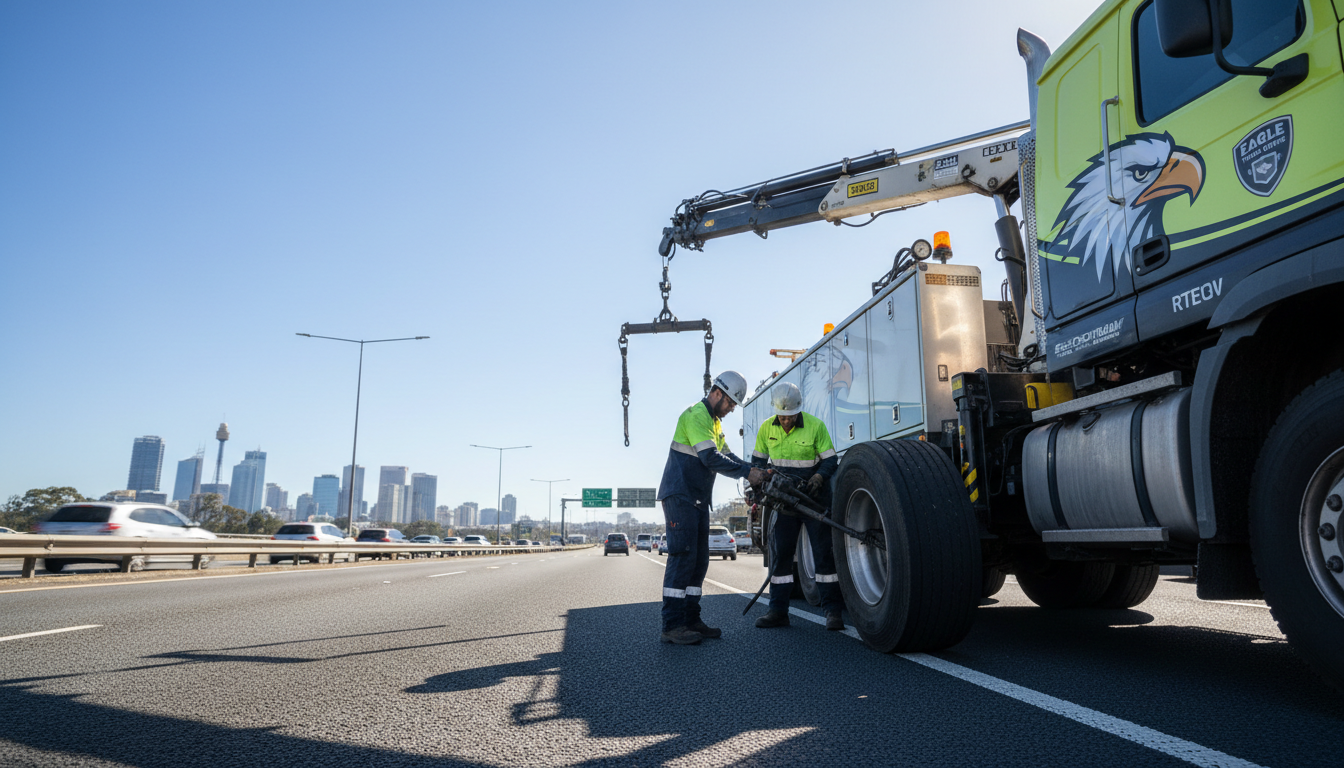
A rigid truck with a blown steer axle tyre sits immobilized on the M7 motorway during peak freight hours. The driver faces a decision that will determine whether the load reaches its destination on time or incurs costly delay penalties. This scenario plays out daily across Western Sydney’s freight corridors, where transport operators must choose between mobile truck tyre services and workshop-based repairs. Each service model offers distinct advantages depending on the urgency, complexity, and operational context of the tyre issue. Understanding when to deploy mobile technicians versus utilizing workshop facilities directly impacts compliance with Heavy Vehicle National Law (HVNL) roadworthiness obligations, operational efficiency, and bottom-line costs for NSW transport operators.
Eagle Truck Centre has serviced Sydney’s heavy vehicle operators since 2015, providing both 24/7 mobile truck tyre services and comprehensive workshop facilities at Smeaton Grange and Emu Plains. This operational experience across thousands of tyre service calls reveals clear patterns about which service model delivers superior efficiency for specific scenarios.
When Mobile Truck Tyre Services Are the Most Efficient Choice
The benefits of mobile truck tyre services become most apparent in situations where vehicle immobilization creates immediate operational or safety consequences. Mobile service delivery eliminates towing costs, reduces downtime, and maintains schedule integrity for time-sensitive freight operations. The National Heavy Vehicle Regulator (NHVR) reports that tyre defects contribute to approximately 3% of heavy vehicle roadworthiness failures during Transport for NSW inspections, with many of these failures occurring unexpectedly during operations rather than during scheduled maintenance windows.
Roadside Breakdowns and Urgent Tyre Failures
Roadside tyre failures represent the clearest case for mobile truck tyre service deployment. When a vehicle experiences a catastrophic tyre failure on a motorway, arterial road, or remote freight route, the emergency mobile tyre replacement procedures provide faster resolution than arranging heavy vehicle towing to a workshop facility. Towing costs for rigid trucks typically range from $400 to $800 depending on distance, while semi-trailer towing can exceed $1,200 for metropolitan Sydney routes.
Mobile services deliver replacement tyres directly to the breakdown location, with response times across Western Sydney freight corridors typically ranging from 45 minutes to 2 hours depending on traffic conditions and technician availability. This response window is generally faster than the combined time required to arrange towing, transport the vehicle to a workshop, and wait for service bay availability during peak operational hours.
The Work Health and Safety Act 2011 (NSW) requires specific safety protocols for roadside tyre repairs, including proper traffic management, vehicle stabilization, and technician personal protective equipment. Professional mobile tyre services maintain these safety standards while operating in roadside environments, whereas attempting self-repair or using unqualified assistance creates significant liability exposure for transport operators.
SafeWork NSW data indicates that roadside tyre failures account for a significant proportion of heavy vehicle incidents on NSW highways, with proper tyre maintenance reducing breakdown risk by up to 40%. When breakdowns do occur, mobile truck tyres for roadside failures provide the fastest path to restoring HVNL-compliant roadworthiness and resuming freight operations.
Time-Critical Deliveries and Tight Schedules
Transport operators managing time-critical deliveries face substantial financial penalties for late arrivals at distribution centres, retail chains, and manufacturing facilities. According to the Bureau of Infrastructure and Transport Research Economics (BITRE), unplanned heavy vehicle downtime costs Australian transport operators an average of $800 to $1,500 per day in lost productivity. For high-value freight or just-in-time delivery contracts, these costs escalate significantly when delay penalties and customer relationship impacts are factored into the calculation.
Mobile truck tyre services allow operators to maintain schedule integrity by bringing the workshop to the vehicle rather than diverting the vehicle to a workshop. When a driver identifies a tyre issue during pre-trip inspection or experiences a slow leak during transit, mobile technicians can meet the vehicle at a depot, rest area, or customer loading dock to perform repairs while other operational activities continue. This approach minimizes the total service window and prevents cascading schedule disruptions across multi-drop delivery routes.
The efficiency advantage becomes particularly pronounced for interstate freight operations where workshop detours add significant distance and time to already tight delivery schedules. Mobile services allow drivers to continue toward their destination while technicians mobilize to intercept at strategic points along the freight route, reducing total downtime compared to backtracking to the nearest workshop facility.
Multi-Vehicle Fleet Operations Across Sydney Depots
Fleet operators managing multiple vehicles across Sydney depot locations often achieve superior efficiency by scheduling mobile tyre services at their own facilities rather than rotating vehicles through workshop appointments. This approach eliminates vehicle transit time, allows technicians to service multiple units during a single site visit, and enables fleet managers to coordinate tyre work around operational schedules rather than workshop availability.
Mobile services prove particularly efficient for depot-based operations in Western Sydney industrial precincts including Eastern Creek, Wetherill Park, and Ingleburn, where concentrating tyre work at the fleet’s home location reduces the logistical complexity of managing workshop appointments across multiple vehicles. Technicians can service steer axle tyres, drive axle tyres, and trailer tyres across an entire fleet during scheduled downtime periods, ensuring all vehicles meet Transport for NSW Heavy Vehicle Inspection Scheme requirements without disrupting daily operations.
This model works best when fleet managers maintain accurate tyre condition records and schedule mobile services proactively based on tread depth measurements, tyre age, and operational wear patterns. The efficiency gains diminish when mobile services are used reactively for emergency repairs rather than as part of a structured maintenance program.
When Workshop Tyre Services Are More Efficient
Workshop facilities provide controlled environments with specialized equipment that certain tyre service scenarios require for proper diagnosis, repair, and compliance verification. While mobile services excel at straightforward tyre replacements and emergency repairs, workshops deliver superior efficiency for complex diagnostic work, precision adjustments, and comprehensive fleet maintenance programs.
Complex Tyre Diagnostics and Alignment Issues
Premature or irregular tyre wear patterns often indicate underlying mechanical issues that require diagnostic equipment unavailable in mobile service configurations. Understanding truck tyre wear patterns helps identify when workshop diagnostics are necessary, particularly when tyres show feathering, cupping, or uneven wear across the tread surface.
Wheel alignment corrections require precision measurement equipment and controlled conditions that mobile services cannot replicate. When steer axle tyres show rapid shoulder wear or drive axle tyres exhibit diagonal wear patterns, the root cause typically involves alignment geometry, suspension component wear, or axle mass distribution issues. Workshop facilities provide the lifting equipment, alignment measurement systems, and diagnostic tools necessary to identify and correct these underlying problems rather than simply replacing worn tyres without addressing causation.
Similarly, suspension-related tyre wear requires comprehensive inspection of spring assemblies, shock absorbers, bushings, and mounting hardware. These inspections demand vehicle lifting and detailed component examination that mobile technicians cannot perform in roadside or depot environments. Choosing the right truck tyres for your fleet becomes irrelevant if underlying mechanical issues destroy new tyres prematurely, making workshop diagnostics the more cost-efficient long-term approach.
Workshop services also provide superior efficiency for precision wheel balancing, particularly for steer axle applications where imbalance creates driver fatigue and accelerates steering component wear. While mobile technicians can perform basic static balancing, dynamic balancing equipment in workshop facilities delivers the precision necessary for high-speed highway operations.
Scheduled Fleet Maintenance and Tyre Rotations
Comprehensive fleet maintenance programs that include tyre rotations, detailed tread depth documentation, and systematic pressure checks across multiple axle positions benefit from workshop environments where technicians have immediate access to lifting equipment, compressed air systems, and complete tyre inventories. Regular tyre maintenance for commercial trucks requires systematic processes that workshops facilitate more efficiently than mobile services.
Tyre rotation programs that maximize tread life by moving tyres between axle positions require simultaneous access to multiple wheel positions and the ability to track individual tyre serial numbers across rotation cycles. Workshop facilities provide the controlled environment and record-keeping systems necessary to maintain accurate rotation schedules that comply with National Heavy Vehicle Regulator (NHVR) maintenance documentation requirements.
Scheduled maintenance also allows workshop technicians to perform complementary inspections including brake system checks, wheel bearing assessments, and hub seal examinations that identify potential issues before they cause roadside failures. This integrated approach delivers better value than isolated mobile tyre services that address only the immediate tyre concern without examining related components.
For fleet operators with consistent maintenance schedules and predictable vehicle availability, workshop appointments provide cost advantages through volume pricing, efficient parts management, and the ability to bundle tyre work with other scheduled services. The efficiency equation shifts toward workshops when operators can plan service timing rather than reacting to emergency failures.
Cost Efficiency: Comparing Mobile vs Workshop Service Models
The total cost comparison between mobile truck tyre services and workshop repairs extends beyond the immediate service invoice to encompass towing expenses, downtime losses, delivery delay penalties, and the opportunity cost of vehicle unavailability. Transport operators must evaluate these factors within their specific operational context to determine which service model delivers superior cost efficiency.
The Bureau of Infrastructure and Transport Research Economics (BITRE) data showing $800 to $1,500 daily downtime costs for Australian transport operators provides context for this comparison. When a mobile service reduces total downtime from 6 hours to 2 hours, the $200 to $400 saved in productive operating time often exceeds any premium charged for mobile service delivery. This calculation becomes even more favorable when delivery delay penalties or customer relationship impacts are considered.
Conversely, for scheduled maintenance where timing flexibility exists, workshop services typically deliver lower per-tyre costs through volume pricing, efficient parts handling, and the ability to perform complementary inspections during the same service appointment. Fleet operators managing preventing expensive truck breakdowns through proactive maintenance programs often achieve better cost efficiency by scheduling workshop appointments during planned downtime rather than paying mobile service premiums.
The optimal approach for most transport operators involves maintaining relationships with service providers who offer both mobile and workshop capabilities, allowing the operator to select the most cost-efficient service model based on each specific situation’s urgency, complexity, and operational context.
HVNL Compliance and Roadworthiness Considerations for Both Service Types
The Heavy Vehicle National Law (HVNL) establishes roadworthiness standards that apply equally to tyres installed through mobile services and workshop facilities. The National Heavy Vehicle Regulator (NHVR) requires all heavy vehicle tyres to meet specific performance criteria regardless of where installation occurs, including proper load index ratings for the axle position, adequate tread depth of minimum 1.5mm across the central three-quarters of the tread, correct inflation pressure appropriate to the load, and freedom from structural defects including cuts, bulges, or exposed cords.
Mobile tyre technicians must carry documentation proving that supplied tyres meet Australian Design Rule requirements and match the vehicle’s placard specifications for load capacity and speed rating. This documentation requirement applies identically to workshop installations, with operators required to retain service records showing tyre specifications, installation dates, and technician qualifications.
Tyre pressure verification presents a practical consideration where workshop services may offer advantages. Workshop facilities typically maintain calibrated pressure monitoring equipment and controlled environments that facilitate accurate pressure setting to manufacturer specifications, typically ranging from 8 to 9 bar for common heavy vehicle applications depending on load and axle position. Mobile technicians carry portable pressure equipment, but ambient temperature variations and time constraints during emergency repairs can affect pressure setting accuracy.
Both service models must provide documentation suitable for Transport for NSW Heavy Vehicle Inspection Scheme requirements, including service invoices that specify tyre brand, size, load index, speed rating, and installation date. Operators preparing vehicles for annual safety inspections should verify that their service provider, whether mobile or workshop-based, supplies documentation meeting these regulatory standards.
The Work Health and Safety Act 2011 (NSW) imposes additional obligations on mobile tyre services operating in roadside environments, including traffic management protocols, vehicle stabilization procedures, and technician safety equipment. Reputable mobile service providers maintain documented safety management systems addressing these requirements, but operators should verify that their chosen provider demonstrates compliance with these workplace safety obligations.
How Eagle Truck Centre Delivers Both Mobile and Workshop Tyre Solutions
Eagle Truck Centre operates both 24/7 mobile truck tyre services across Western Sydney and comprehensive workshop facilities at Smeaton Grange (79 Hartley Rd, Smeaton Grange NSW 2567) and Emu Plains (104 Russell St, Emu Plains NSW 2750 — Truck Tyre Centre). This dual-capability model allows transport operators to select the most efficient service option based on each situation’s specific requirements rather than being constrained by a single service delivery method.
Our mobile units carry comprehensive inventories of Bridgestone, Dunlop, Hankook, Achilles, and Remington tyres covering common steer axle, drive axle, and trailer applications. Mobile technicians respond to breakdowns across major Western Sydney freight corridors including the M7, M4, and Hume Highway, with typical response times of 45 minutes to 2 hours depending on location and traffic conditions. All mobile installations meet National Heavy Vehicle Regulator (NHVR) roadworthiness standards and include documentation suitable for Transport for NSW Heavy Vehicle Inspection Scheme compliance verification.
Workshop facilities at Smeaton Grange and Emu Plains provide the diagnostic equipment, lifting capacity, and controlled environments necessary for complex tyre issues including wheel alignment corrections, suspension-related wear diagnosis, and precision balancing for high-speed applications. Fleet operators scheduling regular maintenance benefit from volume pricing and the ability to coordinate tyre work with complementary services during planned downtime periods.
Since 2015, Eagle Truck Centre has serviced thousands of heavy vehicles across both service models, developing operational expertise in matching service delivery methods to specific operator requirements. Our team helps transport operators evaluate whether mobile or workshop services deliver superior efficiency for their particular situation, considering factors including urgency, tyre issue complexity, schedule constraints, and total cost including downtime impacts.
- ✓
Assess urgency: Is the vehicle immobilized on a roadway or can it safely reach a workshop? - ✓
Evaluate tyre issue complexity: Is it a straightforward puncture or does it involve alignment, suspension, or multiple axle concerns? - ✓
Calculate total downtime cost: Compare mobile service response time plus repair duration against towing time, workshop wait time, and delivery delay penalties - ✓
Check HVNL compliance requirements: Does the repair need to be documented for Transport for NSW Heavy Vehicle Inspection Scheme records? - ✓
Consider fleet scheduling: Can multiple vehicles be serviced simultaneously at a depot using mobile services? - ✓
Review tyre inventory: Does the mobile service carry the required tyre brand, size, and load rating specification for your vehicle? - ✓
Verify technician qualifications: Confirm mobile technicians are trained to meet National Heavy Vehicle Regulator (NHVR) roadworthiness standards
Frequently Asked Questions
Are mobile truck tyre services compliant with HVNL roadworthiness standards?
Yes, mobile truck tyre services must meet the same Heavy Vehicle National Law (HVNL) roadworthiness standards as workshop repairs. The National Heavy Vehicle Regulator (NHVR) requires all tyre installations to meet load rating, tread depth, and pressure specifications regardless of service location. Mobile technicians must ensure tyres comply with Transport for NSW Heavy Vehicle Inspection Scheme requirements, including proper load index ratings for the axle position, minimum 1.5mm tread depth, and correct inflation pressure. Reputable mobile service providers supply documentation showing tyre specifications, installation dates, and compliance with Australian Design Rule requirements suitable for regulatory verification.
Can mobile tyre services handle all tyre sizes for heavy vehicles?
Mobile truck tyre services can handle most common heavy vehicle tyre sizes including steer, drive, and trailer tyres for rigid trucks, semi-trailers, and B-doubles. However, specialized applications such as low-profile tyres, oversized mining tyres, or tyres requiring precision alignment equipment are more efficiently serviced in a workshop environment with dedicated lifting and diagnostic equipment. Mobile units typically carry inventories covering standard commercial tyre sizes from major manufacturers including Bridgestone, Dunlop, and Hankook, but operators with unusual tyre specifications should confirm availability before requesting mobile service.
How quickly can a mobile truck tyre service reach a breakdown in Western Sydney?
Response times for mobile truck tyre services in Western Sydney typically range from 45 minutes to 2 hours depending on location and traffic conditions. Eagle Truck Centre operates 24/7 mobile services from Smeaton Grange and Emu Plains, providing coverage across major freight routes including the M7, M4, and Hume Highway corridors. Response times vary based on technician availability, distance from the service base, and traffic conditions during peak freight hours. Operators should provide accurate location information and vehicle details when requesting mobile service to facilitate efficient dispatch and ensure the mobile unit carries appropriate tyre specifications.
Is mobile tyre service more expensive than bringing my truck to a workshop?
Mobile truck tyre services typically include a callout fee and may have higher per-tyre labour costs, but they eliminate towing expenses, reduce downtime, and prevent delivery delays. For time-critical freight operations, the total cost of mobile service is often lower than the combined cost of towing, workshop fees, and lost revenue from delayed deliveries. According to the Bureau of Infrastructure and Transport Research Economics (BITRE), unplanned heavy vehicle downtime costs Australian transport operators an average of $800 to $1,500 per day. When mobile service reduces downtime from 6 hours to 2 hours, the productivity savings often exceed any premium charged for mobile delivery, particularly when delivery delay penalties are considered.
What tyre issues require a workshop instead of mobile service?
Workshop tyre services are more efficient for wheel alignment corrections, suspension-related tyre wear diagnosis, precision balancing for high-speed applications, and situations requiring multiple axle tyre replacements with comprehensive vehicle inspection. Workshops provide controlled environments with diagnostic equipment necessary for identifying underlying mechanical issues causing premature tyre wear, including alignment geometry problems, suspension component wear, and axle mass distribution issues. When tyres show irregular wear patterns such as feathering, cupping, or uneven shoulder wear, workshop diagnostics are necessary to address root causes rather than simply replacing worn tyres without correcting the underlying problem.
Eagle Truck Centre provides both 24/7 mobile truck tyre services across Western Sydney and comprehensive workshop facilities at Smeaton Grange and Emu Plains. With over 10 years of experience serving NSW transport operators, our technicians deliver HVNL-compliant tyre solutions whether you need urgent roadside assistance or scheduled fleet maintenance. Contact us to discuss the most efficient service option for your operation.
24/7 mobile roadside assistance. Three locations across South West and Western Sydney. Operating since 2015.