
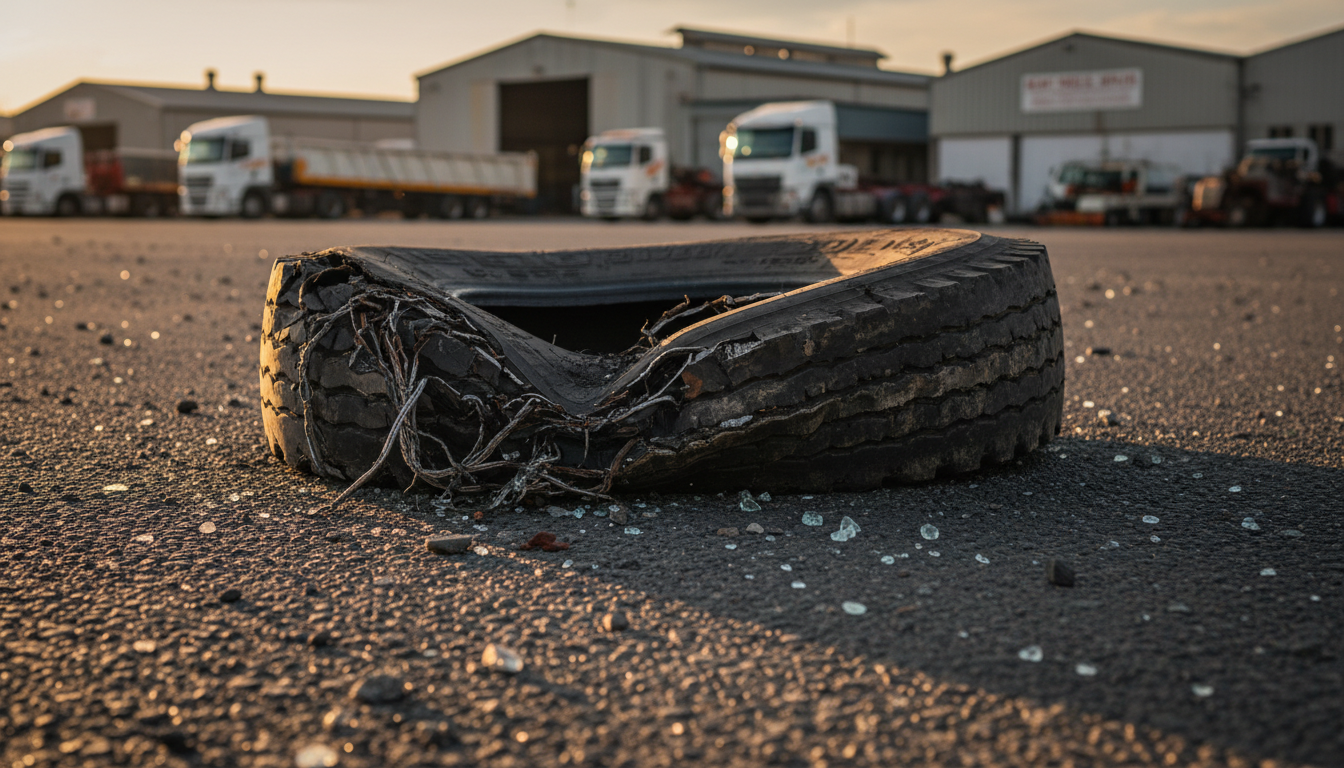
Tyre defects remain one of the most frequently identified mechanical failures during roadside heavy vehicle inspections conducted by the National Heavy Vehicle Regulator (NHVR) across Australia. For operators running heavy vehicles on NSW roads, understanding the root causes of tyre failures is critical to maintaining compliance with the Heavy Vehicle National Law (HVNL) and avoiding costly breakdowns. When failures occur, access to mobile truck tyre repairs can mean the difference between minor disruption and extended downtime. Eagle Truck Centre has serviced Sydney’s heavy vehicle operators since 2015, providing both preventative maintenance and emergency roadside tyre assistance across Greater Sydney.
This diagnostic guide examines the operational and environmental factors that lead to blowouts, tread separation, and sidewall damage on Australian roads, with specific reference to Transport for NSW Heavy Vehicle Inspection Scheme standards and NHVR Mass, Dimension and Loading requirements.
Industry Data
- —The National Heavy Vehicle Regulator (NHVR) reports that tyre defects are among the top five mechanical defect categories identified during roadside heavy vehicle inspections across Australia
- —According to the Bureau of Infrastructure and Transport Research Economics (BITRE), heavy vehicle crashes involving tyre failure result in significantly higher repair costs and downtime compared to other mechanical failures
Overloading and Exceeding Tyre Load Ratings
Exceeding a tyre’s load index rating is a primary cause of premature failure in heavy vehicle operations. Each tyre carries a load index number that specifies the maximum mass it can safely support at a given inflation pressure. When operators exceed axle group limits defined by the National Heavy Vehicle Regulator (NHVR) Mass, Dimension and Loading requirements, the tyres experience excessive heat buildup in the carcass and sidewalls, leading to structural breakdown.
Overloading accelerates wear on drive axle tyres and trailer tyres, where the additional mass increases rolling resistance and generates temperatures that degrade rubber compounds. Steer axle tyres face particular risk, as overloading reduces steering response and increases the likelihood of catastrophic failure at highway speeds. The Heavy Vehicle National Law (HVNL) mandates that operators must not exceed the manufacturer’s specified axle mass limits, which directly correlate to the combined load capacity of all tyres on that axle.
Operators should verify that tyres are selecting tyres with appropriate load ratings for their specific operational requirements, including maximum payload configurations. Ply rating also influences load capacity, with higher ply ratings providing greater structural strength for heavy-duty applications.
Incorrect Tyre Pressure: Under-Inflation and Over-Inflation
Maintaining correct tyre pressure is fundamental to preventing premature failure. Heavy vehicle tyres typically operate between 8 and 9 bar (800-900 kPa) depending on axle position and load configuration, with steer axle tyres often requiring higher pressures than drive or trailer positions.
Under-inflation causes excessive flexing of the tyre sidewalls, generating heat that breaks down the internal structure. This condition accelerates tread wear on the outer edges and increases rolling resistance, reducing fuel efficiency. Under-inflated tyres are also more susceptible to impact damage from road hazards, as the reduced internal pressure provides less cushioning against sharp objects or potholes.
Over-inflation creates a smaller contact patch with the road surface, concentrating wear in the centre of the tread. This reduces traction and increases the risk of tread separation, particularly under heavy braking or cornering loads. Over-inflated tyres are also more prone to catastrophic failure from impact damage, as the rigid carcass cannot absorb shock effectively.
The National Heavy Vehicle Regulator (NHVR) requires that tyre pressures be checked as part of routine maintenance schedules, with weekly inspections recommended for vehicles operating under high-load conditions. Operators should reference the tyre manufacturer’s pressure specifications for each axle position and adjust pressures based on actual load configurations.
Inadequate Tyre Maintenance and Inspection Frequency
Failure to implement proper tyre maintenance practices accelerates wear and increases the likelihood of roadside failures. The Heavy Vehicle National Law (HVNL) mandates daily pre-trip inspections that include visual checks of all tyres for cuts, bulges, exposed cords, and adequate tread depth. However, visual inspections alone are insufficient to identify pressure loss or internal structural damage.
Detailed inspections should occur weekly or every 1,000km, whichever comes first, and must include pressure checks using a calibrated gauge. This frequency aligns with regular tyre maintenance schedules recommended by the National Heavy Vehicle Regulator (NHVR) for commercial operations. Operators should record inspection results in maintenance logs to demonstrate compliance during Transport for NSW Heavy Vehicle Inspection Scheme audits.
Tread depth monitoring is particularly critical. Under the Transport for NSW Heavy Vehicle Inspection Scheme, steer axle tyres must maintain a minimum tread depth of 1.6mm across the full width of the tread, while drive and trailer axle tyres require 1mm minimum. Tyres approaching these limits should be scheduled for replacement before they reach the legal threshold, as worn tyres provide reduced traction in wet conditions and are more susceptible to punctures.
Eagle Truck Centre provides scheduled tyre inspections and maintenance services at our Smeaton Grange NSW 2567 (79 Hartley Rd) and Emu Plains NSW 2750 (104 Russell St — Truck Tyre Centre) locations, with mobile inspection services available across Greater Sydney for fleet operators requiring on-site assessments.
Uneven Tread Wear and Alignment Issues
Uneven tread wear patterns indicate underlying mechanical issues that, if unaddressed, will lead to premature tyre failure. Common wear patterns include shoulder wear, centre wear, cupping, and feathering, each pointing to specific causes.
Shoulder wear on both edges of the tread typically results from chronic under-inflation, while centre wear indicates over-inflation. One-sided shoulder wear suggests misalignment or suspension problems affecting that wheel position. Cupping or scalloping appears as dips around the tread circumference and indicates worn suspension components, unbalanced wheels, or incorrect toe settings. Feathering, where tread ribs are worn smooth on one side and sharp on the other, points to toe misalignment.
Operators should implement recognising abnormal tyre wear patterns as part of routine inspections. Alignment checks should occur every 80,000-100,000km or whenever uneven wear becomes apparent. Misalignment not only reduces tyre life but also increases rolling resistance and fuel consumption.
Suspension components including springs, bushings, and shock absorbers should be inspected during scheduled maintenance intervals. Worn suspension allows excessive wheel movement, creating inconsistent contact patches that accelerate tread wear and increase the risk of sudden failure.
Road Hazards and Impact Damage
Impact damage from road hazards represents an immediate threat to tyre integrity. Potholes, debris, kerb strikes, and sharp objects can cause sidewall cuts, bulges, or internal structural damage that may not be immediately visible.
Sidewall damage is particularly serious, as the sidewall contains the structural cords that maintain tyre shape and support load. Any cut deeper than 6mm or any bulge indicating separation of internal plies constitutes an immediate roadworthiness failure under the Heavy Vehicle National Law (HVNL). Driving on damaged tyres creates a serious safety risk and may result in penalties during Transport for NSW roadside inspections.
Punctures in the tread area can often be repaired if they are less than 6mm in diameter and located in the central three-quarters of the tread. However, punctures in the shoulder area or sidewall cannot be safely repaired and require tyre replacement. Operators should never attempt temporary repairs using plugs or sealants on heavy vehicle tyres, as these do not meet the structural requirements for safe operation under load.
When impact damage occurs, operators should arrange for immediate inspection by a qualified tyre technician. Eagle Truck Centre provides 24/7 mobile roadside assistance to assess damage and perform mobile truck tyre repair or replacement as required.
Heat, Road Conditions, and Environmental Factors
Operating temperatures significantly influence tyre performance and longevity. Australian road surfaces can exceed 60°C during summer months, particularly on Western Sydney routes serviced from our Emu Plains NSW 2750 location. This ambient heat combines with heat generated by tyre flexing under load, creating internal temperatures that accelerate rubber degradation.
High temperatures reduce tyre pressure tolerance, making properly inflated tyres more susceptible to over-inflation as air expands. Conversely, under-inflated tyres generate excessive heat through increased sidewall flexing, creating a compounding effect that can lead to rapid structural failure.
Road surface conditions also affect tyre wear rates. Rough or abrasive surfaces accelerate tread wear, while smooth surfaces may reduce traction. Operators running routes through construction zones or unpaved areas should expect shorter tyre life and implement more frequent inspections. Understanding how Australian weather conditions impact tyre performance allows operators to adjust maintenance schedules based on seasonal factors.
Wet conditions reduce traction, particularly on tyres with worn tread. The minimum legal tread depth of 1.5mm for steer axles and 1mm for other positions provides minimal water evacuation capacity. Operators should consider replacing tyres before they reach legal minimums if vehicles regularly operate in wet conditions.
Age-Related Tyre Degradation and UV Exposure
Tyre age affects structural integrity regardless of tread depth. Rubber compounds degrade over time through oxidation and UV exposure, causing hardening and cracking. This process accelerates in tyres exposed to direct sunlight during extended periods of storage or parking.
Most tyre manufacturers recommend replacement after 7-10 years from the date of manufacture, regardless of remaining tread depth. The manufacture date is encoded in the DOT number on the sidewall, with the last four digits indicating the week and year of production. For example, “2318” indicates the tyre was manufactured in the 23rd week of 2018.
Operators should inspect older tyres for sidewall cracking, particularly in the lower sidewall area and between tread ribs. Fine surface cracks (checking) indicate early-stage degradation, while deeper cracks that expose underlying cords require immediate replacement. Tyres stored outdoors or on vehicles parked in direct sunlight experience faster degradation than those stored in covered facilities.
The Work Health and Safety Act 2011 (NSW) places responsibility on operators to maintain equipment in safe working condition. Using tyres beyond their serviceable life creates unnecessary risk to drivers and other road users, and may affect insurance coverage in the event of an incident.
Non-Compliance with HVNL Roadworthiness Standards
The Heavy Vehicle National Law (HVNL) establishes minimum roadworthiness standards that all heavy vehicles must meet. Tyre-related standards under the Transport for NSW Heavy Vehicle Inspection Scheme include minimum tread depth requirements, prohibition of visible structural damage, correct tyre sizing for the axle position, and absence of exposed cords or fabric.
Common compliance failures identified during roadside inspections include tyres worn below minimum tread depth, mismatched tyre sizes on the same axle, mixing of radial and bias-ply tyres, and operation with visible sidewall damage. Any of these conditions can result in immediate defect notices requiring rectification before the vehicle can continue operating.
The National Heavy Vehicle Regulator (NHVR) conducts targeted enforcement campaigns focusing on tyre condition, particularly during high-risk periods such as holiday travel seasons. Operators found with serious tyre defects may face penalties including fines, demerit points under the National Heavy Vehicle Accreditation Scheme, and vehicle grounding until defects are rectified.
Maintaining comprehensive maintenance records demonstrates due diligence and supports compliance during audits. Records should include tyre inspection dates, pressure readings, tread depth measurements, and details of any repairs or replacements performed.
When to Call for Mobile Truck Tyre Repairs
Certain tyre failures require immediate professional response to maintain safety and minimise downtime. Operators should arrange for mobile truck tyre repairs when experiencing flat tyres, visible sidewall damage, rapid pressure loss, or any condition that prevents safe vehicle operation.
Mobile truck tyre repair services provide on-site assessment and, where appropriate, temporary or permanent repairs that allow the vehicle to return to service. However, not all tyre damage can be safely repaired. Sidewall damage, punctures larger than 6mm, or damage to the shoulder area typically require tyre replacement rather than repair.
Eagle Truck Centre operates 24/7 mobile roadside assistance across Greater Sydney, with technicians equipped to assess damage, perform compliant repairs, or replace tyres on-site. Our mobile service carries a range of Bridgestone, Dunlop, Hankook, Achilles, and Remington tyres suitable for steer, drive, and trailer axle applications. Understanding emergency mobile tyre replacement procedures helps operators respond effectively when failures occur on remote routes.
When calling for mobile truck tyre repair, operators should provide the vehicle location, tyre position requiring service, vehicle configuration (number of axles), and any visible damage details. This information allows technicians to arrive with appropriate equipment and replacement tyres if required.
For scheduled maintenance or non-urgent tyre concerns, operators can access services at our fixed locations in Smeaton Grange NSW 2567 (79 Hartley Rd), Emu Plains NSW 2750 (104 Russell St — Truck Tyre Centre), or Sydney NSW 2000, where comprehensive tyre inspections, alignments, and replacements can be performed in controlled workshop environments.
Frequently Asked Questions
What is the minimum legal tread depth for truck tyres in NSW?
Under the Heavy Vehicle National Law (HVNL) and Transport for NSW Heavy Vehicle Inspection Scheme, steer axle tyres must have a minimum tread depth of 1.6mm across the full width of the tread, while all other axles require 1mm minimum. Tyres below these limits will fail roadworthiness inspections.
How does overloading cause truck tyre failures?
Exceeding a tyre’s load rating—specified by its load index—generates excessive heat in the tyre carcass and sidewalls, leading to structural failure. The National Heavy Vehicle Regulator (NHVR) Mass, Dimension and Loading requirements mandate that operators must not exceed axle group limits, which directly correlate to tyre load capacity.
Can I drive on a truck tyre with visible sidewall damage?
No. Sidewall cuts, bulges, or exposed cords constitute an immediate roadworthiness failure under the Heavy Vehicle National Law (HVNL). Driving on damaged tyres creates a serious safety risk and may result in penalties during Transport for NSW inspections or roadside enforcement.
How often should truck tyres be inspected for wear and damage?
The National Heavy Vehicle Regulator (NHVR) requires daily pre-trip inspections that include visual tyre checks for damage, tread depth, and correct inflation. Detailed inspections including pressure checks should occur weekly or every 1,000km, whichever comes first, as part of a compliant maintenance schedule.
Eagle Truck Centre provides mobile truck tyre repairs and 24/7 roadside tyre replacements across Sydney, backed by over 10 years of heavy vehicle experience. Contact us for immediate assistance or scheduled tyre maintenance.
24/7 mobile roadside assistance. Three locations across South West and Western Sydney. Operating since 2015.