Industry Data
- —According to the National Heavy Vehicle Regulator (NHVR), defective brakes and steering systems are among the most common roadworthiness defects identified during heavy vehicle inspections across Australia.
- —Transport for NSW data shows that heavy vehicles operating in urban and regional NSW are subject to roadside inspections under the Heavy Vehicle Inspection Scheme, with cleanliness of safety components directly affecting inspection outcomes.
- —SafeWork NSW reports that proper vehicle maintenance, including regular cleaning of brake and suspension components, reduces the risk of mechanical failure and workplace incidents involving heavy vehicles.
A full service truck wash provides comprehensive cleaning of heavy vehicle chassis, underbody, suspension and brake components alongside cab and trailer exterior surfaces. For fleet operators and owner-drivers managing heavy vehicles under the Heavy Vehicle National Law (HVNL), a full service truck wash supports inspection readiness and enables proper visual assessment of safety-critical systems required under Transport for NSW Heavy Vehicle Inspection Scheme protocols.
Understanding what a full service truck wash includes helps transport operators make informed decisions about vehicle maintenance scheduling and compliance preparation. This service goes beyond basic exterior cleaning to address the chassis rails, cross members, wheel arches, brake calipers, air lines and suspension mounts that accumulate road grime, diesel residue and chemical contamination during normal operations.
What Is a Full Service Truck Wash?
A full service truck wash is a comprehensive cleaning process that addresses all accessible surfaces of a heavy vehicle, including areas not covered by standard exterior wash services. The service targets chassis and underbody components where road grime, hydraulic fluid, diesel spills and salt accumulation can obscure visual inspection of safety-critical systems.
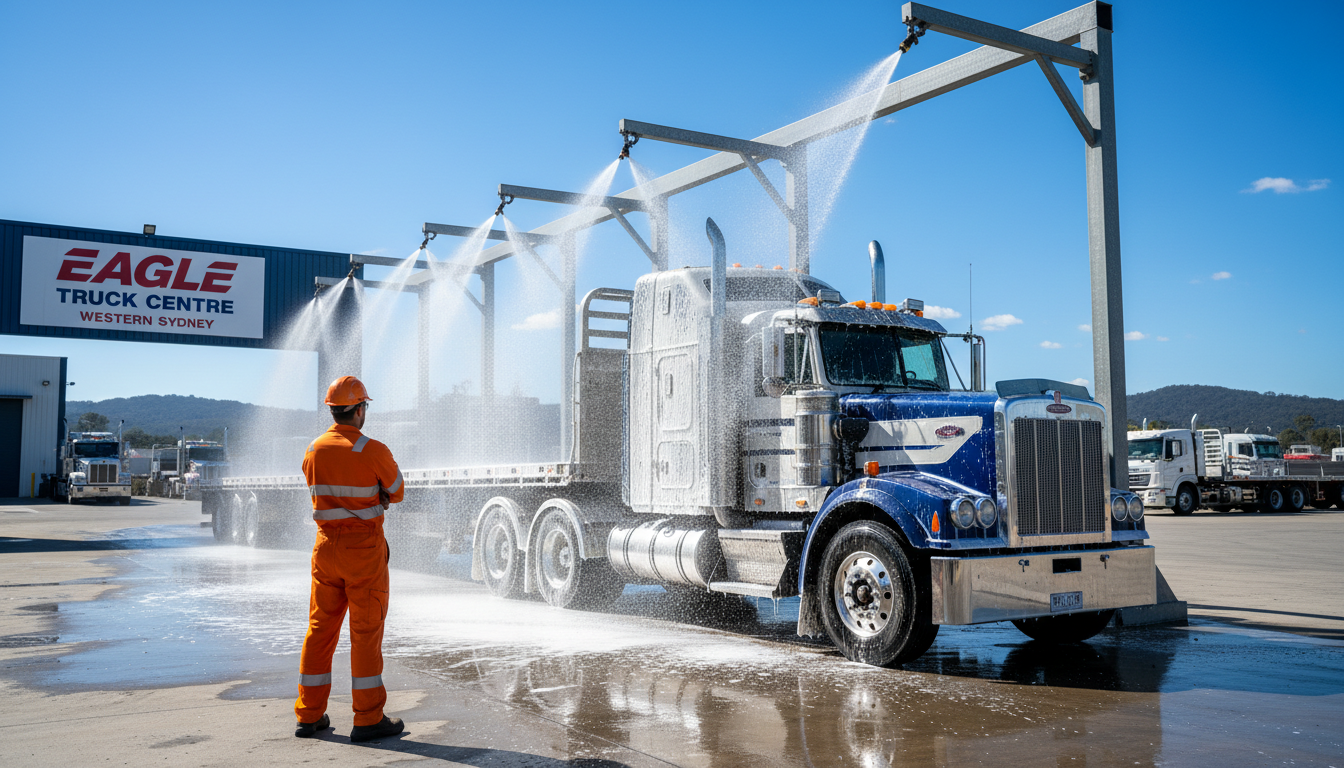
Unlike a basic wash that focuses on cab and trailer exterior panels, a full service truck wash uses high-pressure cleaning equipment and industrial degreasers to remove built-up contamination from chassis rails, suspension components, brake assemblies and wheel arches. This level of cleaning is particularly relevant for operators preparing vehicles for Transport for NSW Heavy Vehicle Inspection Scheme assessments, where inspectors require clear visibility of brake lines, steering linkages and suspension mounting points.
The service typically includes cab exterior wash, trailer body cleaning, chassis degreasing, underbody high-pressure wash, wheel arch and mudguard detailing, and cleaning of suspension components including leaf springs, airbag assemblies and shock absorbers. For rigid trucks, semi-trailers, B-doubles and road trains operating across Greater Sydney and regional NSW, this comprehensive approach supports both roadworthiness obligations under the HVNL and workplace safety requirements under the Work Health and Safety Act 2011 (NSW).
What’s Included in Eagle Truck Centre’s Full Service Truck Wash
Eagle Truck Centre has delivered professional full service truck wash and truck tyre services across South West and Western Sydney since 2015. The full service truck wash package addresses every component that affects vehicle inspection outcomes and operational safety.
The service begins with cab exterior cleaning, including windscreen, mirrors, door panels and steps. High-pressure wash removes road film, insect residue and diesel splash from painted surfaces. All lights, indicators and reflectors receive attention to ensure visibility compliance under Australian Design Rules.
Trailer body cleaning covers side panels, rear doors, curtains and roof surfaces. For tipper bodies and tankers, the service includes cleaning of hydraulic rams, PTO assemblies and discharge valves. Refrigerated trailers receive condenser unit cleaning to maintain cooling efficiency.
Chassis degreasing targets the main chassis rails, cross members, fifth wheel assemblies and subframe components. Industrial degreasers break down accumulated oil, hydraulic fluid and road tar that standard detergents cannot remove. This step is critical for operators preparing vehicles for Transport for NSW inspections, where chassis corrosion and structural defects must be visible for proper assessment.
Underbody high-pressure wash removes packed mud, gravel and chemical residue from areas between chassis rails, around fuel tanks and along exhaust systems. Clean underbody surfaces allow pre-trip inspection of air lines, electrical wiring and fluid leaks that indicate developing mechanical issues.
Wheel arch and mudguard cleaning removes compacted dirt that can restrict brake cooling airflow and obscure suspension component condition. For multi-axle configurations, each wheel position receives individual attention to ensure brake calipers, slack adjusters and ABS sensors are visible and accessible for inspection.
Chassis and Underbody Cleaning: Why It Matters for Heavy Vehicles
Chassis and underbody cleaning directly supports compliance with Heavy Vehicle National Law (HVNL) roadworthiness obligations. The HVNL requires operators to maintain vehicles in a condition that does not pose a safety risk, which includes ensuring that safety-critical components can be properly inspected during pre-trip checks and scheduled maintenance.
According to the National Heavy Vehicle Regulator (NHVR), defective brakes and steering systems are among the most common roadworthiness defects identified during heavy vehicle inspections across Australia. Clean chassis and underbody surfaces allow mechanics and inspectors to identify early warning signs including fluid leaks from brake chambers, cracked air lines, worn suspension bushings and corroded chassis rails.
For operators subject to Transport for NSW Heavy Vehicle Inspection Scheme assessments, chassis cleanliness directly affects inspection outcomes. Inspectors require clear visibility of brake components, steering linkages, suspension mounts and chassis structural integrity. Heavy contamination can result in inspection delays or requirements to re-present the vehicle after cleaning, adding downtime and administrative burden to fleet operations.
Underbody cleaning also supports the identification of load-related damage. Vehicles operating under National Heavy Vehicle Regulator (NHVR) Mass, Dimension and Loading requirements must maintain structural integrity appropriate to their load rating. Chassis rail deformation, cracked cross members and damaged mounting brackets are easier to identify on clean surfaces, allowing operators to address structural issues before they compromise load security or vehicle stability.
Wheel Arch, Mudguard and Suspension Component Wash
Wheel arch and mudguard cleaning removes packed debris that accumulates during operations on unsealed roads, construction sites and agricultural properties. This contamination can restrict airflow to brake assemblies, reducing cooling efficiency and contributing to brake fade during sustained downhill operation or heavy braking events.
For vehicles fitted with drum brakes on drive and trailer axles, wheel arch cleanliness affects brake temperature management. Packed mud acts as insulation, trapping heat generated during braking and reducing the natural convection cooling that drum brake systems rely on. Clean wheel arches restore airflow and support consistent brake performance across all axle positions.
Suspension component wash addresses leaf springs, airbag assemblies, shock absorbers and torque rods. Road salt, chemical spray and agricultural residue accelerate corrosion of suspension hardware, particularly spring hangers, shackle pins and U-bolt assemblies. Regular cleaning extends component life and allows visual identification of worn bushings, cracked spring leaves and damaged airbag bellows during routine pre-trip inspections.
For operators managing mixed fleets that include both urban delivery vehicles and regional linehaul units, suspension cleaning frequency varies based on operating environment. Vehicles running sealed highway routes accumulate less contamination than units operating on unsealed roads or in coastal areas where salt spray accelerates corrosion. Tailoring wash frequency to operating conditions optimises maintenance spend while supporting component longevity.
Full Service Truck Wash vs Basic Wash: Key Differences
The distinction between full service truck wash and basic wash lies in the scope of cleaning and the components addressed. A basic wash covers cab and trailer exterior surfaces visible from ground level, focusing on painted panels, doors and side curtains. This service maintains fleet presentation and removes surface dirt but does not address underbody or chassis contamination.
A full service truck wash includes all basic wash components plus chassis degreasing, underbody high-pressure cleaning, wheel arch detailing and suspension component wash. The service requires additional time and specialised equipment including undercarriage wash systems and industrial degreasers capable of breaking down oil, hydraulic fluid and road tar.
For fleet operators, the choice between basic and full service wash depends on operational requirements and compliance schedules. Vehicles operating primarily on sealed urban routes may require full service wash quarterly, while units running unsealed roads or operating in corrosive environments benefit from monthly full service attention. Understanding the differences helps operators allocate maintenance resources effectively while meeting roadworthiness obligations. For detailed service comparison, review our guide on complete truck detailing vs high pressure wash.
How Full Service Truck Wash Supports Transport for NSW Inspection Readiness
Transport for NSW Heavy Vehicle Inspection Scheme assessments require clear visibility of safety-critical components including brakes, steering, suspension and chassis structure. Transport for NSW data shows that heavy vehicles operating in urban and regional NSW are subject to roadside inspections under the Heavy Vehicle Inspection Scheme, with cleanliness of safety components directly affecting inspection outcomes.
A full service truck wash prepares vehicles for inspection by removing contamination that obscures component condition. Inspectors assess brake adjustment, air line integrity, suspension mounting security and chassis structural soundness. Heavy accumulation of road grime, oil residue or packed mud can prevent proper assessment, resulting in inspection delays or requirements to re-present the vehicle after cleaning.
For operators scheduling periodic inspections or preparing vehicles for registration renewal, booking a full service truck wash 24 to 48 hours before the inspection appointment ensures components are visible and accessible. This timing allows cleaned surfaces to dry completely while providing a buffer for any mechanical issues identified during post-wash visual inspection to be addressed before the formal assessment.
Eagle Truck Centre’s RTA wash services for Transport for NSW inspections combine full service truck wash with focused attention to inspection-critical areas including brake adjusters, steering linkages and suspension mounts. This targeted approach supports first-time inspection pass rates and reduces administrative burden associated with re-inspection requirements.
Full Service Truck Wash and Heavy Vehicle Roadworthiness
Roadworthiness under the Heavy Vehicle National Law (HVNL) requires vehicles to be maintained in a condition that does not pose a safety risk. While the HVNL does not mandate specific wash frequency, it requires operators to maintain vehicles in a state that allows proper inspection of safety systems and does not compromise structural integrity or component function.
Regular full service truck wash supports roadworthiness by enabling early identification of developing defects. Clean brake components allow visual inspection of chamber pushrod travel, slack adjuster condition and air line integrity. Clean suspension systems reveal worn bushings, cracked spring leaves and damaged airbag bellows before they progress to failure. Clean chassis surfaces expose corrosion, cracking and deformation that indicate structural fatigue or overloading damage.
For operators managing Chain of Responsibility obligations under the HVNL, documented maintenance including regular cleaning demonstrates due diligence in vehicle upkeep. Wash service records combined with inspection reports and repair documentation create an audit trail that supports compliance defence in the event of incident investigation or regulatory audit.
SafeWork NSW reports that proper vehicle maintenance, including regular cleaning of brake and suspension components, reduces the risk of mechanical failure and workplace incidents involving heavy vehicles. For operators subject to Work Health and Safety Act 2011 (NSW) obligations, full service truck wash forms part of the preventive maintenance program that manages workplace risks associated with heavy vehicle operations. Additional guidance on keeping your fleet clean and compliant provides broader context for integrating wash services into safety management systems.
Why Professional Full Service Truck Wash Matters for Fleet Operators
Professional full service truck wash delivers consistent results using equipment and techniques designed for heavy vehicle cleaning. Commercial wash facilities use high-pressure systems capable of 2000 to 3000 psi output, significantly exceeding domestic pressure washers that typically operate at 1000 to 1500 psi. This pressure differential affects cleaning effectiveness on packed mud, road tar and industrial contamination.
Industrial degreasers used in professional truck wash services are formulated to break down diesel fuel, hydraulic oil, transmission fluid and gear oil without damaging painted surfaces, rubber components or electrical connections. These products achieve cleaning results that general-purpose detergents cannot match, particularly on chassis rails, cross members and suspension components where oil contamination accumulates over time.
Professional facilities also provide proper wastewater management. Wash runoff containing oil, fuel residue and chemical contamination requires treatment before discharge to stormwater systems. Licensed truck wash facilities operate under environmental protection requirements that ensure contaminated water receives appropriate treatment, protecting operators from environmental liability associated with improper disposal.
For fleet operators managing multiple vehicles, professional wash services deliver time efficiency. A full service truck wash at a commercial facility takes 45 to 90 minutes depending on vehicle configuration, compared to three to four hours for equivalent cleaning using on-site equipment and manual labour. This time saving translates to reduced vehicle downtime and improved fleet utilisation. The benefits of professional truck washing extend beyond cleaning quality to operational efficiency and regulatory compliance.
How Often Should You Book a Full Service Truck Wash?
Full service truck wash frequency depends on operating environment, route characteristics and cargo type. Vehicles operating on sealed urban and highway routes in dry conditions typically require full service wash every eight to twelve weeks. Units running unsealed roads, construction sites or agricultural properties benefit from monthly full service attention due to accelerated contamination accumulation.
Coastal operations require increased wash frequency due to salt spray exposure. Salt accelerates corrosion of chassis, suspension and brake components, particularly in areas where road spray concentrates including wheel arches, spring hangers and chassis rail flanges. Vehicles operating within 50 kilometres of coastal areas should receive full service wash every four to six weeks to manage salt contamination.
Vehicles hauling corrosive or contaminating loads including chemicals, fertiliser, livestock or waste materials require more frequent cleaning. Spillage and splash contamination from these loads can damage painted surfaces, corrode chassis components and create workplace safety hazards during loading and unloading operations. Post-trip wash after hauling high-risk loads protects vehicle condition and supports workplace safety obligations.
For operators preparing vehicles for Transport for NSW Heavy Vehicle Inspection Scheme assessments, scheduling full service wash 24 to 48 hours before inspection appointments ensures components are clean and visible for inspector assessment. This timing also provides opportunity to identify and address any mechanical issues revealed during post-wash inspection before the formal assessment occurs.
Between professional wash services, drivers can maintain vehicle cleanliness through routine cab exterior cleaning and wheel arch inspection. Guidance on maintaining truck cleanliness between services helps extend the interval between full service washes while supporting daily pre-trip inspection effectiveness.
Full Service Truck Wash as Part of Your Preventive Maintenance Schedule
Full service truck wash integrates into preventive maintenance scheduling alongside tyre rotation, brake adjustment, oil changes and component lubrication. Incorporating wash services into the maintenance calendar ensures consistent vehicle condition and supports early defect identification that reduces repair costs and unplanned downtime.
For fleets operating on fixed service intervals, aligning full service truck wash with scheduled maintenance visits maximises efficiency. A vehicle receiving 20,000 kilometre service can undergo full service wash during the same workshop visit, allowing mechanics to conduct post-wash inspection of chassis, suspension and brake components with clear visibility of component condition.
Wash service records should be maintained alongside other maintenance documentation. Recording wash date, vehicle identification, service type and any defects identified during post-wash inspection creates an audit trail that supports Chain of Responsibility compliance and provides historical data for optimising maintenance intervals based on actual vehicle condition trends.
- 01
Schedule wash services based on operating environmentVehicles on sealed urban routes require full service wash every 8–12 weeks. Units operating unsealed roads, construction sites or coastal areas need monthly attention. Align wash frequency with contamination exposure and Transport for NSW inspection schedules.
- 02
Coordinate wash timing with scheduled maintenanceBook full service truck wash during routine service intervals to allow mechanics clear visibility of chassis, suspension and brake components. Post-wash inspection identifies developing defects before they require emergency repair or cause roadside breakdowns.
- 03
Conduct post-wash inspection of safety-critical systemsAfter full service wash, inspect brake chambers for pushrod travel, check air lines for cracks or chafing, examine suspension bushings for wear, and assess chassis rails for corrosion or structural damage. Document findings in maintenance records to support Heavy Vehicle National Law (HVNL) compliance.
- 04
Maintain wash service records for compliance auditRecord wash date, service type, vehicle identification and any defects identified during post-wash inspection. Retain records alongside other maintenance documentation to demonstrate due diligence under Chain of Responsibility obligations and support regulatory compliance defence.
Integrating full service truck wash into preventive maintenance planning supports the broader goal of maintaining fleet roadworthiness while managing operating costs. For comprehensive maintenance planning guidance, refer to the truck maintenance checklist that covers all scheduled service requirements for heavy vehicles operating under HVNL obligations.
- ✓
Inspect chassis and underbody for oil leaks, fluid drips or corrosion after full service wash - ✓
Check wheel arches and mudguards are free from packed mud or debris that could affect brake cooling - ✓
Verify suspension components, brake lines and air lines are visible and clean for pre-trip inspections - ✓
Examine cab exterior, mirrors and lights are clean and functional for safe road operation - ✓
Review trailer underside and landing gear for grease build-up or road grime accumulation - ✓
Confirm all registration plates, compliance plates and signage are legible after wash - ✓
Schedule next full service truck wash based on operating conditions and Transport for NSW inspection dates
Eagle Truck Centre has delivered professional full service truck wash and truck tyre services across South West and Western Sydney since 2015. Book your full service truck wash at Smeaton Grange or Emu Plains today.
24/7 mobile roadside assistance. Three locations across South West and Western Sydney. Operating since 2015.
Frequently Asked Questions
What’s the difference between a full service truck wash and a basic wash?
A full service truck wash includes chassis degreasing, underbody cleaning, wheel arch and suspension component wash, mudguard detailing, and thorough cab exterior cleaning. Basic wash covers cab and trailer exterior surfaces only, without underbody or chassis attention.
Does a full service truck wash help with Transport for NSW inspections?
Yes. A full service truck wash removes built-up grime from chassis, suspension and brake components, making it easier for Transport for NSW Heavy Vehicle Inspection Scheme inspectors to identify defects during roadworthiness assessments. Clean components allow proper visual inspection of critical safety items.
How long does a full service truck wash take?
A full service truck wash typically takes 45 to 90 minutes depending on vehicle size, configuration and level of soiling. Rigid trucks generally require less time than B-doubles or road trains due to fewer axles and smaller surface area.
Can a full service truck wash remove chemical residue and road grime?
Yes. Full service truck wash uses degreasers and high-pressure cleaning to remove diesel spills, hydraulic fluid, road tar, salt and chemical residue from chassis and underbody areas. For heavy contamination, Eagle Truck Centre offers chemical and acid wash services.
Is full service truck wash necessary for compliance under Heavy Vehicle National Law?
While the Heavy Vehicle National Law (HVNL) does not mandate specific wash frequency, it requires vehicles to be maintained in a roadworthy condition. Regular full service truck wash supports compliance by enabling proper inspection of safety-critical components including brakes, suspension and steering systems.